What the reference sheet gives you
You can open the reference sheet in either Math One of the two timed parts of each SAT section, each with its own clock.Read the lesson. This is everything it prints.
| Shape | What the sheet prints |
|---|---|
| Circle | and |
| Rectangle | |
| Triangle | |
| Right triangle | |
| Special right triangles | --: , , . --: , , |
| Box, cylinder, sphere | , , |
| Cone, rectangular pyramid | , |
It also says a circle has 360 degrees of A piece of a circle's edge between two points on it.Read the lesson, or A unit for measuring angles in which a full circle is 2 pi, the same as 360 degrees.Read the lesson, and that a triangle's angles add to 180 degrees.
A few more facts follow from those. A square is a rectangle with equal sides, so its area is , and a cube's volume is . Halving the circle facts gives radians. Since a The distance straight across a circle through the center, which is twice the radius.Read the lesson is , the sheet's is the same as .
How to use this list
Nothing below is on the sheet, so you need all of it in your head. Each row's name links to the lesson that teaches it, so open that lesson if a row doesn't make sense.
To study, cover the formula column and say each formula from its name. Then go the other way and say what question each formula answers, like "two points, and I need the slope."
Learn these four first: , the percent multiplier , the slope formula and . They come up on more questions than all the geometry rows put together.
If a question needs a formula that isn't here or on the sheet, the question prints it. Plenty of questions need no formula at all, like solving the Two expressions set equal to each other, like 5x + 7 = 22.Read the lesson . If you're stuck on one of those, reread the question and your last line.
Lines and points
| What you need | Formula | Example |
|---|---|---|
| Reading | Slope , The output when the input is 0, which is where a graph crosses the vertical axis.Read the lesson | : slope 4, y-intercept |
| A rate and a starting value | is the amount per unit, and is the amount at the start | $25 to join plus $12 a month: |
| Slope from two points | and : | |
| Point-slope form | Slope 2 through : | |
| Slope of | : | |
| Parallel and perpendicular | Parallel: same slope. Perpendicular: flip the slope and change its sign. A flat line and an upright one are perpendicular too | becomes |
| Solutions of one equation | Simplify first. Same terms, different numbers: none. All the same: infinitely many. Otherwise one | : none |
| Solutions of a system | Same slope, different y-intercepts: none. Same line: infinitely many. Otherwise one | and : none |
| Flipping an inequality | Multiplying or dividing by a negative turns the sign around | gives |
For a slope, subtract in the same order on top and bottom. gives , the right size with the wrong sign.
No lesson teaches distance and midpoint on their own. The distance between two points is the Pythagorean theorem on a grid, with the change in and the change in as the legs. From to that's .
The midpoint averages the two -coordinates and the two -coordinates. Between and it's .
Percents and rates
| What you need | Formula | Example |
|---|---|---|
| A percent of a number | times the number | 15% of 60: |
| An increase or a decrease | Up : times . Down : times | 30% off $70: |
| Percent change | 40 to 50: | |
| Two changes in a row | Multiply the multipliers | Up 10%, then down 10%: |
| A rate | "A per B" is , and distance is | 150 miles in 3 hours: 50 an hour |
| Proportional | , with | when : |
| Density | 60 grams in 12 cubic centimeters: 5 grams per cubic centimeter | |
| Part of a whole | In a A comparison of two amounts, like 3 to 5.Read the lesson of to , the first part is of the whole | 2 to 3: |
| Square and cubic units | Square or cube the conversion number |
A percent change is measured against where you started, so is wrong for 40 to 50. The second of two changes comes off the new amount, which is why up 10% and then down 10% leaves you 1% lower. When a question prints a conversion fact, use the one on the page.
Quadratics
| What you need | Formula | Example |
|---|---|---|
| Vertex from | , then put that in to get | : , vertex |
| Vertex from | The vertex is | : |
| Zeros from | The zeros are and , and the vertex is halfway between | : zeros 1 and , vertex at |
| Quadratic formula | For : | : , so 1 or |
| Discriminant | . Positive: two real solutions. Zero: one. Negative: none | : , one |
| A line touching a parabola | Set them equal, move everything to one side, and touching once means | |
| Sum and product of the solutions | Sum , product | : sum 4, product |
| Completing the square | Halve the number with , square it, and add that to both sides | becomes |
| Difference of squares | ||
| Perfect squares |
A quadratic written as a number times (x minus h) squared, plus k, so you can read the vertex (h, k) right off it.Read the lesson and An expression written as factors multiplied together, like (x - 2)(x + 5), where setting each factor to zero gives a solution.Read the lesson both flip the sign you see. The form subtracts , so means , and is 0 when . Read , and only after every term is on one side.
A question about something thrown upward usually prints , with height in feet. The comes from gravity, is the starting upward speed, and is the height at . The object hits the ground when .
Exponentials and powers
| What you need | Formula | Example |
|---|---|---|
| Exponential model | : starting value , multiplier | starts at 300 and doubles |
| Percent growth or decay | Up : . Down : | Down 8% a year from 500: |
| A change every units | Doubles every 4 hours: | |
| Powers | Same base only: , , | |
| Zero and negative powers | , | |
| Fractional powers |
To check an The small raised number that says how many times to multiply, like the 3 in x cubed.Read the lesson like , put in one period. At it's , one doubling. would give 16 doublings.
Data and probability
| What you need | Formula | Example |
|---|---|---|
| Mean | Total divided by how many values | 4, 7, 10: |
| A missing value | Total needed is the mean times the count | Mean 8 over 5 values: total 40 |
| Two groups combined | 10 averaging 80 and 30 averaging 60: | |
| Median | Sort, then take the middle. With an even count, average the two middle values | 9, 2, 6, 4 sorts to 2, 4, 6, 9: 5 |
| Range and IQR | Range is largest minus smallest. The The spread of the middle half of the data, found by subtracting the lower quartile from the upper quartile.Read the lesson is , the spread of the middle half | A box from 20 to 32: IQR 12 |
| Standard deviation | No formula. Values bunched near the mean give a smaller one | |
| Probability | What you want over the group you're picking from | |
| Not A | ||
| A or B | ||
| A count | How likely something is, written as a number from 0 to 1, like 1/2 for heads on a coin flip.Read the lesson times the total | 0.2 of 150: 30 |
| Margin of error | Estimate plus or minus the margin | 62% plus or minus 4: 58% to 66% |
| From an interval | Estimate is the middle, margin is half the width | 30 to 38: estimate 34, margin 4 |
| Residual | Actual minus predicted | Dot at 18, line at 21: |
In "Of the students who chose B, what fraction are seniors?", you're picking from the students who chose B, so they go on the bottom. "Given that" shrinks the group the same way.
A The actual value minus the value the line of best fit predicts, so a point above the line gives a positive number.Read the lesson is how far a dot sits above or below the The straight line that best follows the trend of the dots in a scatterplot.Read the lesson, so a dot above the line has a positive one.
Right triangles and trigonometry
| What you need | Formula | Example |
|---|---|---|
| Sine, cosine and tangent | , , | Sides 3, 4, 5, at the angle across from 3: , |
| Sides to know by sight | 3-4-5, 5-12-13, 8-15-17, 7-24-25, and their multiples | Legs 9 and 12: The longest side of a right triangle, the one opposite the right angle.Read the lesson 15 |
| Complementary angles | ||
| Sine squared plus cosine squared |
Opposite and adjacent depend on which angle you stand at. The hypotenuse is always the longest side, across from the right angle, so find it before you match a side pattern.
The special triangles on the sheet give these values.
| Angle | Sine | Cosine | Tangent |
|---|---|---|---|
| 1 | |||
For an acute angle, sine and cosine are between 0 and 1, since a leg is shorter than the hypotenuse. Desmos starts in radians, so switch it to Degrees before you type , as Desmos basics shows.
Circles
| What you need | Formula | Example |
|---|---|---|
| The circle's equation | : center , The distance from the center of a circle out to its edge.Read the lesson | : center , radius 6 |
| An arc's degrees | The same as its An angle with its corner at the center of a circle and its two sides reaching the edge.Read the lesson | |
| Arc length | Radius 4, : of , or | |
| Two arcs | The The shorter of the two arcs between two points on a circle.Read the lesson and The longer of the two arcs between two points on a circle.Read the lesson add to , and to the whole The distance all the way around a circle.Read the lesson | leaves |
| Radians and degrees | To degrees, times . To radians, times | |
| Tangent lines | A A line that touches a circle at exactly one point.Read the lesson meets the radius at a right angle. Two tangent segments from one outside point are the same length |
The center's signs are the opposite of the ones you see, so means . The right side is the radius squared, so take its square root before you call it the radius.
Shapes and angles
| What you need | Formula | Example |
|---|---|---|
| Prism | , where is the area of the base | Base area 12, length 10: 120 |
| Perimeter | Add the sides: , or for a square | 7 by 3: 20 |
| Surface area | Box . Cube . Closed cylinder | Cube with edge 3: 54 |
| Scale factor | Lengths times , areas times , volumes times | Lengths doubled: area times 4, volume times 8 |
| Two lines crossing | Angles side by side on a line add to . The two angles across from each other where two lines cross. They are always equal.Read the lesson are equal | |
| Parallel lines | A line crossing them makes two angle sizes that add to | and |
| Right triangle | The two smaller angles add to | |
| Outside angle | The two inside angles at the other corners, added | and : |
| Two equal sides | The base angles are equal, each , where is the angle between the equal sides | : base angles |
| Three equal sides | Every angle is |
A height is measured straight from the base, so a slanted side isn't the height. Halve a diameter before you use a formula that needs the radius.
Practice
Work through the three examples, then try five more. Before you put in any numbers, write the formula you need on scratch paper, or say the rule that gets you to the next line.
Aiko loads 4,600 caps into a bottling line’s feeder before production starts. The feeder uses caps at a constant rate of 725 caps per hour; after 2 hours, 3,150 caps remain. The function gives the number of caps remaining hours after production starts.
Which equation defines ?
- A
- B
- C
- D
Show the answer
- A
This swaps the How steep a line is, measured by how much it goes up for each unit it moves to the right.Read the lesson and Where a graph crosses an axis.Read the lesson. It uses the initial caps as the hourly The number multiplying a letter, like the 5 in 5x.Read the lesson and , the hourly change, as the A number that doesn’t change, like the 7 in 5x + 7, or a letter such as p that stands for one fixed value.Read the lesson term.
- B
This drops the negative sign from the rate. Because the feeder uses caps per hour, the number remaining decreases by each hour.
- CCorrect answer
At , the feeder contains caps, so the A number that doesn’t change, like the 7 in 5x + 7, or a letter such as p that stands for one fixed value.Read the lesson term is . The amount decreases by caps per hour, so the How steep a line is, measured by how much it goes up for each unit it moves to the right.Read the lesson is , giving .
- D
This treats the caps remaining after hours as the value at . The A number that doesn’t change, like the 7 in 5x + 7, or a letter such as p that stands for one fixed value.Read the lesson term must represent the initial amount, which is .
Solution
Use the two stated amounts to calculate the hourly change:
. The How steep a line is, measured by how much it goes up for each unit it moves to the right.Read the lesson is because the feeder loses caps each hour. At , it contains caps, so the Where a graph crosses an axis.Read the lesson is . Therefore, . Checking the given value, , which matches the number of caps remaining after hours.
At Dubois Dairy, the function models energy use, in watt-hours, for a batch completed with churn cycles.
Which value of minimizes the energy use predicted by the model?
- A
- B
- C
- D
Show the answer
- ACorrect answer
For a An expression whose biggest power is a square, like x squared plus 3x minus 4.Read the lesson , the The point where a parabola turns, which is its lowest point if it opens up and its highest if it opens down.Read the lesson occurs at . Here, , and the positive leading The number multiplying a letter, like the 5 in 5x.Read the lesson means the vertex is a minimum.
- B
This results from dropping the negative sign in the The point where a parabola turns, which is its lowest point if it opens up and its highest if it opens down.Read the lesson formula and calculating .
- C
This evaluates the A rule that takes in one number and gives back one number, like f(x) = 5x - 7.Read the lesson at the The point where a parabola turns, which is its lowest point if it opens up and its highest if it opens down.Read the lesson, , and reports the minimum energy use instead of the number of churn cycles.
- D
This omits the factor of in the The bottom number of a fraction, like the 4 in 3/4.Read the lesson and calculates .
Solution
The graph of opens upward because the The number multiplying a letter, like the 5 in 5x.Read the lesson of is positive, so its The point where a parabola turns, which is its lowest point if it opens up and its highest if it opens down.Read the lesson gives the minimum energy use.
For , the vertex The number you put into a function, like the 4 in f(4).Read the lesson is . Substituting and gives . The model therefore predicts minimum energy use at churn cycles.
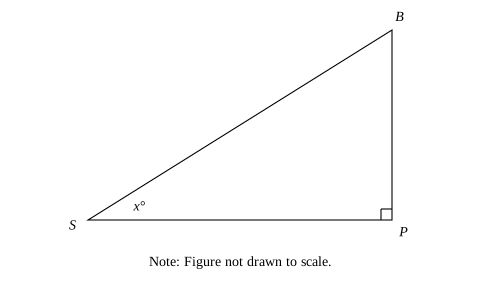
For the acute angle labeled , . What is ?
Show the answer
Accepted answers: 17/29, .5862
Solution
The acute angles in a right triangle are Two angles that add up to 90 degrees.Read the lesson, so . Since , .
A common wrong answer is , which comes from inverting the given A comparison of two amounts, like 3 to 5.Read the lesson. Another common wrong answer is , which comes from calculating instead of .
Note that and are examples of ways to enter a correct answer.
Next steps
Drills need a free account, which also saves your lesson progress on every device. Sign up free
Related lessons
- Math: how the section works
- Linear equations in two variables
- Linear functions
- Linear equations in one variable
- Systems of two linear equations in two variables
- Linear inequalities in one or two variables
- Equivalent expressions
- Nonlinear equations in one variable and systems of equations in two variables
- Nonlinear functions
- Percentages
- Ratios, rates, proportional relationships, and units
- One-variable data: distributions and measures of center and spread
- Two-variable data: models and scatterplots
- Probability and conditional probability
- Inference from sample statistics and margin of error
- Area and volume
- Lines, angles, and triangles
- Right triangles and trigonometry
- Circles
- Desmos basics for the test
- Units, percents, and grid-in entry rules
- Back to all lessons