What the questions look like
Almost every one of these questions says “selected at random.” The last line usually reads like one of these:
- “If one of these students is selected at random, what is the probability of selecting a student who plays a sport?”
- The same question with “given that the student is a senior” added at the end
- “How many of these students play a sport?”, after the question has given you a probability
The counts come from a table, a list of numbers, or a description in a sentence or two. On a A question where you type your own answer instead of picking one of four.Read the lesson, the question ends with “(Express your answer as a decimal or fraction, not as a percent.)”
A probability is the number of picks that fit the description over the number of picks you could make. If 12 of the 30 songs on a playlist are covers, the probability of picking a cover is . It always comes out from 0 to 1, so an answer of 12 is a count that never got divided.
There's nothing to graph in these questions. Choosing the top and bottom of the fraction happens on paper. After that, Desmos can do the arithmetic.
Out of which group?
Here are the 80 tickets sold for a school play.
| Ticket | Matinee | Evening | Total |
|---|---|---|---|
| Adult | 20 | 30 | 50 |
| Child | 16 | 14 | 30 |
| Total | 36 | 44 | 80 |
If one of these tickets is selected at random, what is the probability of selecting a child ticket, given that the ticket is for the matinee?
Read to the end before you touch the table. “Given that the ticket is for the matinee” means you're only picking from matinee tickets, so every evening ticket is out.
Keep only the matinee column. These 36 tickets are the only ones you can pick.
In that column, count the child tickets.
Put the matinee total on the bottom and the child count on top.
Divide the top and bottom by 4.
The top number always comes from inside the bottom group. Here the 16 child matinee tickets sit inside the 36 matinee tickets, so the fraction makes sense.
When the last line changes, the bottom can change too. Here are four questions about the same table.
| The question asks for | Bottom | Answer |
|---|---|---|
| a child ticket | all 80 | |
| a child matinee ticket | all 80 | |
| a child ticket, given matinee | 36 matinee | |
| a matinee ticket, given child | 30 child |
A question about a child matinee ticket (or a ticket that's “child and matinee”) points at one cell, 16. Nothing in it rules out any tickets, though, so you're still picking from all 80.
Trap: The condition read backward
is a choice on the “child, given matinee” question. It has the right top, 16, over the 30 child tickets, which answers “matinee, given child.”
What to do: Say the question as “Out of the matinee tickets, how many are child tickets?” The group after “out of” goes on the bottom.
Trap: The grand total on the bottom
is a choice on the same question. It puts the right 16 over all 80 tickets, as if the evening tickets could still be picked.
What to do: If the question says “given that” or names a smaller group to pick from, the grand total in the corner of the table can't be your bottom.
A group named at the start of the question works the same as “given that.”
- Do this
- Read “If one of the matinee tickets is selected at random” as the group, and put 36 on the bottom.
- Not this
- Wait for the words “given that” before you shrink the bottom.
The question names the group before it names the ticket you want, so you're already picking only from matinee tickets. The answer is 16/36 again.
Conditions that cover several rows
When the condition covers more than one row, add those rows to get the bottom. This table covers every pair of shoes in a store, and every price is a whole number of dollars. It gives each cell as a share of all the pairs instead of a count, so the grand total is 1.00. You work it the same way.
| Price | On sale | Full price | Total |
|---|---|---|---|
| Under $25 | 0.23 | 0.08 | 0.31 |
| $25 to $59 | 0.16 | 0.26 | 0.42 |
| $60 or more | 0.07 | 0.20 | 0.27 |
| Total | 0.46 | 0.54 | 1.00 |
If one of these pairs is selected at random, which of the following is closest to the probability that it's on sale, given that it costs less than $60?
Keep the under-$25 row and the $25 to $59 row. A $60 pair doesn't count, so the last row is out. Add the two totals for the bottom.
In those two rows, add the on-sale shares for the top.
Divide, and round only at the end.
You don't need to turn the shares into counts first.
Whether a $60 pair counts comes down to the wording of the condition.
| Wording | Does 60 count? |
|---|---|
| at least 60, 60 or more | Yes |
| more than 60, greater than 60 | No |
| at most 60, 60 or fewer | Yes |
| less than 60, fewer than 60 | No |
A band labeled “40 to 60” adds nothing to “more than 60,” since even its top value, 60, isn't more than 60.
Trap: Only part of the range
is the $25 to $59 row alone, . It leaves out the pairs under $25, which also cost less than $60.
What to do: Write down every row the wording covers before you add, and test the boundary number itself: does a $60 pair count?
A table of shares still needs the condition's total on the bottom.
- Do this
- Divide 0.39 by 0.73, the share of pairs that cost less than $60.
- Not this
- Stop at 0.39, since the table already gives shares.
0.39 is a share of every pair in the store. The question asks for a share of only the pairs that cost less than $60.
A condition can have a “not” in it. “Given that it doesn't cost $60 or more” keeps the same two rows. You can also get there by subtracting the $60-or-more row: on the bottom and on top. Make both subtractions, or the top still counts pairs you've ruled out.
Now try one with counts in place of shares.
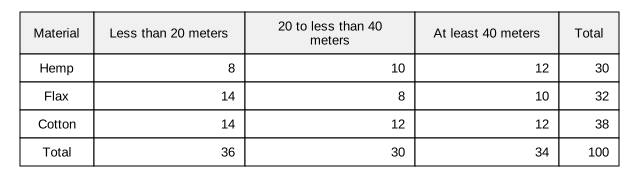
At a rope walk, Salim prepares strands of three materials to be twisted into ropes. He sorts each strand into exactly one length category. The table gives the numbers of strands by material and length, in meters. One of these strands will be selected at random.
What is the probability of selecting a hemp strand, given that its length is at least 20 meters?
- A
- B
- C
- D
Show the answer
- A
Using puts all strands in the The bottom number of a fraction, like the 4 in 3/4.Read the lesson. The condition “at least 20 meters” limits the denominator to the strands that meet that condition.
- BCorrect answer
The length condition includes the “20 to less than 40 meters” and “At least 40 meters” columns, which contain strands. Of these, are hemp, so the How likely something is, written as a number from 0 to 1, like 1/2 for heads on a coin flip.Read the lesson is .
- C
Using counts only the strands at least meters long in both the The top number of a fraction, like the 3 in 3/4.Read the lesson and The bottom number of a fraction, like the 4 in 3/4.Read the lesson. This leaves out the “20 to less than 40 meters” category, which also satisfies “at least 20 meters.”
- D
Using reverses the condition: it gives the How likely something is, written as a number from 0 to 1, like 1/2 for heads on a coin flip.Read the lesson that a strand is at least meters long given that it is hemp. The stated condition restricts the selection to strands at least meters long.
Solution
“Given that its length is at least 20 meters” restricts the possible selections to the “20 to less than 40 meters” and “At least 40 meters” columns. Add their totals to get eligible strands.
In the hemp row, those columns contain strands. Divide the number of eligible hemp strands by the total number of eligible strands: .
When you have to build the table
Sometimes there's no table, just a description. Build a small table yourself before you write the fraction.
A bakery made 6 trays of 15 muffins and 4 trays of 12 scones. By noon it had sold 2 trays of muffins and 1 tray of scones. If one of the items left is selected at random, what is the probability that it's a scone?
Muffin trays left.
Scone trays left.
Muffins left: 4 trays of 15.
Scones left: 3 trays of 12.
| Item | Trays left | Items left |
|---|---|---|
| Muffin | 4 | 60 |
| Scone | 3 | 36 |
Add the items left. That's the group you're picking from.
The scones left go on top.
Divide the top and bottom by 12.
Trap: Counting trays, or the wrong group
counts trays: 3 of the 7 trays left hold scones, but a muffin tray holds more items than a scone tray. And counts every muffin and scone baked, including the ones already sold.
What to do: Turn trays into items first. Then check that the bottom counts only the items you can still pick.
To count a set of whole numbers, divide. Of the whole numbers from 1 to 90, are multiples of 3, so the probability of picking one is .
Watch for a total that's then split into parts. “A cooler holds 20 bottles of juice, 12 apple and 8 grape, plus 15 bottles of water” describes 35 bottles. The 12 and the 8 are the same 20 juice bottles, so adding 20, 12, 8 and 15 counts every juice bottle twice. The probability of an apple juice is .
Not and neither
Slow down at “not,” “neither,” “other than” and “outside.” Each one changes which picks count. Of the 80 play tickets, 36 are for the matinee. For a ticket that's not for the matinee, take those 36 out and count what's left.
Take the 36 matinee tickets out of all 80.
Put what's left over all 80.
Divide the top and bottom by 4.
That's the same as .
Trap: The “not” dropped
is the probability of a matinee ticket, the very tickets the question rules out. It and the right answer add to 1.
What to do: Once you have an answer, ask whether it counts the tickets that are left or the ones you took out.
“Neither A nor B” means not A and not B, so both groups come out.
A drawer holds 50 socks: 9 red, 5 green, 21 black and the rest gray. If one sock is selected at random, what is the probability that it's neither black nor gray?
A sock that's neither black nor gray is red or green. Count those.
Put them over all 50 socks.
Divide the top and bottom by 2.
That's quicker than taking both colors out of 50, since you'd have to work out the gray count first.
Trap: Half the “neither”
takes out the 21 black socks and leaves the gray ones in. counts the black and gray socks, the ones the question rules out. And 14 alone is a count.
What to do: Take out every group named after “neither” and after “nor,” then count what's left.
Two “nots” can come together. This table sorts 70 jackets.
| Size | Hood | No hood | Total |
|---|---|---|---|
| Small | 11 | 27 | 38 |
| Large | 19 | 13 | 32 |
| Total | 30 | 40 | 70 |
For a jacket that's not large and doesn't have a hood, turn each “not” into what's left. Not large means small, and no hood means the no-hood column. The only cell that's both is small with no hood, 27, so the probability is . Adding all 38 small jackets to all 40 no-hood jackets gives 78, more jackets than there are, because the 27 got counted twice.
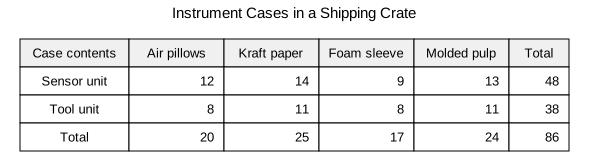
Quentin packed instrument cases into a shipping crate. Each case contains either a sensor unit or a tool unit and uses exactly one type of protective packing. The table shows the distribution of the cases.
If one of these cases is selected at random, what is the probability of selecting a case that uses neither a foam sleeve nor molded pulp?
- A
- B
- C
- D
Show the answer
- A
This adds the foam-sleeve cases and molded-pulp cases, giving the How likely something is, written as a number from 0 to 1, like 1/2 for heads on a coin flip.Read the lesson of selecting one of the excluded packing types. The question asks for the complement of that event.
- BCorrect answer
The qualifying cases use air pillows or kraft paper, so their count is . Out of total cases, the How likely something is, written as a number from 0 to 1, like 1/2 for heads on a coin flip.Read the lesson is .
- C
This counts only the kraft-paper cases. It omits the air-pillow cases, which also use neither a foam sleeve nor molded pulp.
- D
This removes only the foam-sleeve cases from the total. The molded-pulp cases must also be removed.
Solution
A case that uses neither a foam sleeve nor molded pulp must use air pillows or kraft paper. The table shows air-pillow cases and kraft-paper cases, so the number that satisfy the condition is
. There are cases in all. Therefore, the How likely something is, written as a number from 0 to 1, like 1/2 for heads on a coin flip.Read the lesson is
. The fraction cannot be reduced because and have no common factor greater than .
A or B
Here's the ticket table again.
| Ticket | Matinee | Evening | Total |
|---|---|---|---|
| Adult | 20 | 30 | 50 |
| Child | 16 | 14 | 30 |
| Total | 36 | 44 | 80 |
If one ticket is selected at random, what is the probability that it's a child ticket or a matinee ticket? “Or” counts a ticket that's either one, or both.
Add the child total and the matinee total.
The 16 child matinee tickets are in both totals. Take them out once.
Put it over all 80 tickets.
Divide the top and bottom by 10.
To check, count the cells that fit: 20 adult matinee, 16 child matinee and 14 child evening make 50. As a grid-in, enter 5/8 or .625.
Written with for “the probability of,” the rule looks like this.
Probability of A or B
Trap: Overlap counted twice
adds the two totals and leaves the 16 child matinee tickets in twice.
What to do: After you add the two totals, subtract the cell they share. Or count each cell that fits once.
When nothing can be in both groups, there's nothing to subtract. A soccer team scored 1, 0, 2, 1, 3, 0, 1, 4, 2, 1, 0 and 1 goals in its 12 games. Tally each value: 0 shows up three times and 1 shows up five times. A game can't end with both 0 and 1 goals, so the probability of picking a game with 0 or 1 goals is .
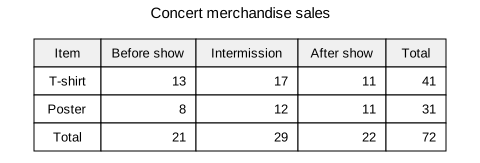
Cyrus recorded the merchandise sales at a concert. Each sale was for exactly one type of item and occurred during exactly one of the three time periods shown.
If one of these sales is selected at random, what is the probability that the sale was for a poster or occurred before the show? (Express your answer as a decimal or fraction, not as a percent.)
Show the answer
Accepted answers: 11/18, .6111
Solution
There are 31 poster sales and 21 sales before the show. The 8 posters sold before the show appear in both counts, so subtract them once: . Divide by all 72 sales: . A response of adds without subtracting the 8 sales counted in both groups. A response of uses the union count of 44 but divides by the 31 poster sales instead of all 72 sales. A response of finds the How likely something is, written as a number from 0 to 1, like 1/2 for heads on a coin flip.Read the lesson that a sale was neither for a poster nor before the show.
Note that and are examples of ways to enter a correct answer.
From a probability to a count
Some questions give you a probability and ask how many. The count is the probability times the total.
A ferry carried 600 vehicles, and each was a car, a van or a motorcycle. Of these, 30 were motorcycles. If one vehicle is selected at random, the probability that it's a van is 0.15. How many of the vehicles were cars?
Turn the van probability into a count: multiply by the total.
Add the vans and the motorcycles.
Every vehicle is in one of the three groups, so the cars are the rest.
Trap: The leftover from one number
510 takes only the vans out, , and leaves the motorcycles in with the cars. 90 is , the number of vans.
What to do: Turn every group you're given into a count, then take them all out of the total.
Trap: A count handed in as a probability
is the probability of a car, and the question asks how many. And dividing, , gives more vehicles than the ferry carried.
What to do: Reread the last line. “How many” asks for a count, so multiply by the total. “What is the probability” asks for a fraction or a decimal.
Matching the choices
Say 6 of the 15 mugs on a shelf are blue. The probability of picking a blue one is , which reduces to .
Write your answer in the form the choices use.
- Do this
- If all four choices are over 15, pick 6/15.
- Not this
- Decide your work is wrong because 2/5 isn't there.
6/15 and 2/5 are the same number. If your answer is missing, reduce it or divide it out before you redo the work.
A grid-in takes up to five characters for a positive answer. Enter a fraction or a decimal, never a percent.
- Right
- For , enter 7/12, .5833 or 0.583.
- Wrong
- For , enter 58.3% or 0.58.
A percent sign isn't allowed, and 0.58 stops before the box is full, so it isn't precise enough.
If Desmos shows a long decimal, the small round fraction button on the result row turns it into a fraction that may fit the box. The grid-in lesson covers entry rules in more detail.
Practice
Before you start each one, find the group you're picking from and write its total on the bottom. Then check that everything you count on top is inside that group.
Next steps
Drills need a free account, which also saves your lesson progress on every device. Sign up free
Related lessons