What the questions look like
The last line of the question usually names a unit, and that tells you what to find.
- “What is the area, in square inches, of the triangle?” Square units, so it's an area.
- “What is the volume, in cubic centimeters, of the cone?” Cubic units, so it's a volume.
- “What is the length, in inches, of an edge of the base?” A plain unit, so it's a length, often worked back from an area or a volume.
- “The volume of the sphere is cubic feet. What is the value of ?” It wants the number in front of .
Two more cues tell you the kind of work. “Similar” or “each side is 3 times as long” means a scaled-up figure. “Total” or “not taken up” means two pieces to add or subtract.
Desmos does the arithmetic, but it can't pick the formula or tell you which side is the height.
Picking the formula
The The page of formulas you can open at any point in the Math section.Read the lesson gives the area of a rectangle, a triangle and a circle, and the volume of a box, a cylinder, a sphere, a cone and a rectangular pyramid. Copy the formula onto scratch paper before you put any numbers in.
Trap: The fraction left off
A pyramid with a 6 by 5 base and height 8 has volume . The choice 240 leaves off the one-third. Dropping a triangle's one-half doubles its area the same way, and using 4 for a sphere's triples its volume.
What to do: Copy the whole formula from the sheet, then put the numbers into your copy.
A square is a rectangle with equal sides, so its area is . A cube is a box with three equal edges, so its volume is . A cube with edge 5 has volume . The wrong choices 25 and 30 come from and .
The sheet's box formula works only when the base is a rectangle. A prism is any solid with the same shape all the way through, like a tent. Multiply the area of one end by the length.
Prism volume
, where is the area of the base
Say the end is a triangle with base 6 and height 4, and the solid is 10 long.
Find the area of the triangle at the end.
Multiply by the length, which is here.
Multiplying 6, 4 and 10 gives 240, which treats the triangle as a rectangle.
The distance all the way around a flat shape., the distance around, isn't on the sheet either. It's for a rectangle and for a square.
Trap: Perimeter given for area
A rectangle 11 by 4 has area 44 square units. The choice 30 is its perimeter, and 15 just adds the two sides.
What to do: Before you start, say whether the question asks for area or perimeter.
Surface area
Surface area is the total area of every outside face. It isn't on the sheet, so you build it face by face.
Add the area of every face.
- Right
- Box 2 by 4 by 5, faces 8, 10 and 20: surface area .
- Wrong
- Box 2 by 4 by 5, faces 8, 10 and 20: surface area .
A box has three pairs of matching faces, and 38 counts one face from each pair.
The box's volume, , is in cubic units, so it can't be a surface area. A cube has six equal square faces, so its surface area is . A box with no lid has only five faces.
The four side faces of a box unroll into one rectangle as wide as the base's perimeter. Standing on its 2 by 4 face, this box's sides make .
A closed cylinder has two circles for lids and a curved side. Unroll the side and it's a rectangle. Its width is the distance around the circle, , and its height is the cylinder's height.
A closed cylinder has a base area of square inches and a height of 10 inches. What's its surface area?
Get the radius from the base area: .
Two lids, each .
The side: the distance around times the height.
Add the lids and the side.
Trap: A face missing, or the volume
counts one lid, and is the side alone. is the volume, , in cubic inches.
What to do: For a closed cylinder, count two lids plus the side, and check that your answer is in square units.
Some questions give the height as a letter. With height , the same steps give .
Finding the lengths
Write down each length the formula needs before you multiply. Some take a step to find.
A rectangle is 6 wide, and its length is 3 more than twice its width.
Turn the description into a number before you use it.
- Right
- Length , so the area is .
- Wrong
- Length , so the area is .
Twice the width, then 3 more. Only the 6 gets doubled.
In the same way, “12 longer than the width” means . Multiplying the width by 12 is the slip to watch for.
The height in any area or volume formula meets the base at a right angle. This triangle has base 10, a height of 6, and a slanted side of 8.
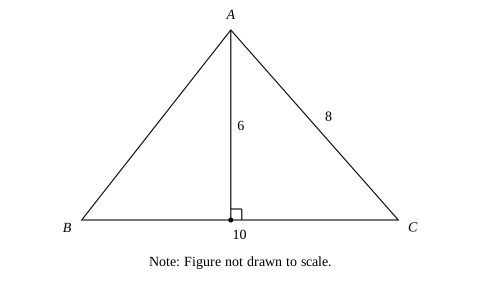
Use the height that stands straight up from the base.
- Right
- square units.
- Wrong
- square units.
The side of 8 leans. It doesn't meet the base at a right angle.
A cone works the same way. Its height runs straight down the middle, and the slanted edge you can see is longer.
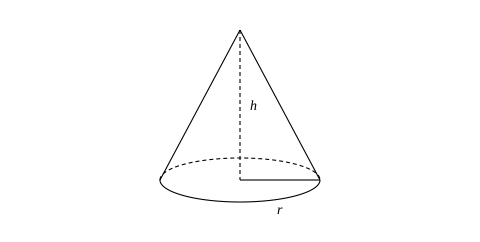
If the height isn't given, you may have to find it first. In a right triangle, get the missing side from , which the right triangles lesson covers. On a graph, a side that runs straight across or straight up and down is as long as the difference between its ends' coordinates.
Mixed units
Change every length to the unit the answer needs before you multiply.
- Right
- 2 feet by 18 inches: square feet.
- Wrong
- 2 feet by 18 inches: square feet.
36 multiplies feet by inches, so it isn't square feet or square inches.
Converting an area or a volume takes the conversion squared or cubed. A foot is 12 inches, so a square foot is square inches and a cubic foot is cubic inches.
Watch for two unit words in one question, like a tank measured in feet with the water's depth in inches, or a price per square yard for a floor measured in feet.
Round shapes and answers with π
The The distance straight across a circle through the center, which is twice the radius. goes all the way across through the center, so it's twice the radius. Halve a diameter before it goes into any formula.
Which is the volume of a cone with base diameter 10 and height 12?
- A.
- B.
- C.
- D.
Halve the diameter.
Copy the cone formula from the sheet and put the numbers in.
Square the radius.
, and a third of 300 is 100.
B is correct. A is the area of the base alone, and C leaves off the one-third.
Trap: Diameter used as the radius
D uses 10 as the radius. The radius gets squared, so D is 4 times too big. A sphere's radius gets cubed, so the same slip makes a sphere's volume 8 times too big.
What to do: Write “r =” and its value as soon as you read the question. Halve a diameter, and leave a radius as it is.
When the choices have in them, keep it. Some questions ask for just the number in front of , its The number multiplying a letter, like the 5 in 5x.Read the lesson: “The volume is . What is the value of ?” Keep fractions as fractions. Here's a sphere 3 inches across.
Halve the 3.
Put it into the sphere formula from the sheet.
Cube the top and the bottom: and .
, which simplifies to .
Enter the number in front of .
About 14.14 is the whole volume with multiplied in, so it doesn't answer this question.
Get the number in front of π
- For the cone, type
1/3, press the right arrow, then type*5^2*12. It shows 100, so the answer is . - For the sphere, type
4/3, press the right arrow, then type*1.5^3. It shows 4.5.
Leave pi out when you want the coefficient. If the question is a A question where you type your own answer instead of picking one of four.Read the lesson, the lesson on entering answers covers what fits in the box.
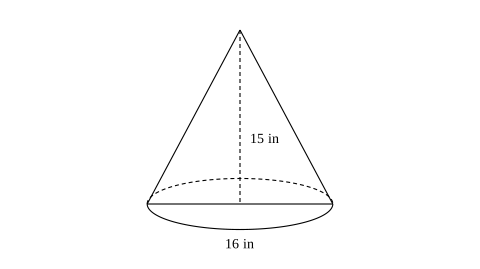
A lighthouse lamp that Salma monitors runs 11 hours nightly. Its housing is shaped like the right circular cone shown.
What is its volume, in cubic inches, in terms of ?
- A
- B
- C
- D
Show the answer
- A
This computes the lateral surface area: the slant height is , so . The question asks for volume.
- BCorrect answer
The The distance from the center of a circle out to its edge.Read the lesson is half the 16-inch The distance straight across a circle through the center, which is twice the radius.Read the lesson, so . Using gives cubic inches.
- C
This drops the from the cone volume formula. Computing gives , three times the cone's volume.
- D
This substitutes the 16-inch The distance straight across a circle through the center, which is twice the radius.Read the lesson for the The distance from the center of a circle out to its edge.Read the lesson in the volume formula. Using gives , four times the volume.
Solution
The cone's The distance straight across a circle through the center, which is twice the radius.Read the lesson is 16 inches, so its The distance from the center of a circle out to its edge.Read the lesson is inches. Its height is 15 inches.
Use the cone volume formula: . Substitute and : . The housing's volume is cubic inches.
Working back to a length
When the question gives a volume and asks for a length, put in what you know and undo the formula one step at a time. If the unknown is squared, the last step is a square root.
A cone holds cubic centimeters and stands 8 centimeters tall. What's its radius?
Put the volume and the height into the cone formula.
Divide both sides by .
Multiply both sides by 3.
Divide both sides by 8.
Take the square root. A length is positive, so keep 6.
Trap: The wrong length reported
36 stops one step early, at . 12 is the diameter. And about 3.46, which is , comes from leaving off the one-third.
What to do: Solve for the letter, then reread what the question asks for.
A pyramid with a square base works the same way.
Undo the one-third and the height to get the base area, then take the square root for the edge.
- Right
- A pyramid with a square base, volume 300 and height 9 has a base edge of 10.
- Wrong
- A pyramid with a square base, volume 300 and height 9 has a base edge of 100.
, so is the area of the square base. The edge is .
Solve it by graphing
- For the pyramid, , so type
3x^2=300. - Desmos draws a vertical line at each solution, and . If you don't see them, zoom out.
- Click where the right-hand line crosses the horizontal One of the two lines a graph is measured against, one running across and one running up. and read 10.
A repair shop bases its parts markup on package dimensions. One right square prism package has height centimeters and volume cubic centimeters.
What is the length, in centimeters, of an edge of the package’s square base?
Show the answer
Accepted answers: 37, 37.0, 37.00
Solution
Let be the length of an edge of the square base. The prism’s volume is its base area times its height, so .
Divide by the height to get . Take the positive square root because a length is positive: centimeters.
The answer reports the base area after dividing the volume by the height. You need to take its square root to find an edge length.
The answer comes from multiplying the calculated edge length by four: . This gives the base The distance all the way around a flat shape.Read the lesson, while the question asks for one edge.
Two pieces
Some questions put two shapes together. Find each piece and write both numbers down. Then add for “total” or “combined,” and subtract for “remaining” or “not taken up.”
Tank A is a cylinder with radius 3 feet and height 10 feet. Tank B holds cubic feet. How much do they hold together?
Tank A's volume.
Add tank B's volume as it's given.
You don't need tank B's radius.
When one solid sits inside another, get the inner one's size from the outer one.
A solid that just fits touches the sides of the one around it. A sphere that just fits in a cube has a radius half the cube's edge.
- Right
- A cylinder that just fits in a box 20 wide has radius 10.
- Wrong
- A cylinder that just fits in a box 20 wide has radius 20.
The box's width goes all the way across the cylinder, so it's the diameter.
A box is 20 by 20 by 30 centimeters, and a cylinder 30 centimeters tall just fits inside. To the nearest cubic centimeter, how much of the box isn't taken up by the cylinder?
The box.
The cylinder, with radius 10.
Box minus cylinder. Keep for now.
Round once, at the end. The full value is about 2,575.22.
Trap: One piece, or rounded too early
9,425 is the cylinder alone, and 12,000 is the box alone. 2,580 uses 3.14 for , which looks close but misses by 5.
What to do: Label both volumes and subtract the inside one from the outside one. Round only the final answer.
In Desmos, type 20*20*30-pi*10^2*30 on one line. The result starts 2575.22, and nothing gets rounded along the way.
Scaled-up figures
Picture a cube 1 inch on each edge next to one 2 inches on each edge. Each edge doubled. Each face went from 1 square inch to 4, since it's 2 by 2. The volume went from 1 cubic inch to 8, since 8 of the small cubes fit inside the big one.
Two figures are similar when one is a scaled-up copy of the other, with every length multiplied by the same number, the The number every length is multiplied by to turn one figure into a bigger or smaller copy of it.Read the lesson . Perimeters multiply by too, areas and surface areas by , and volumes by . The lines, angles, and triangles lesson works the area part with triangles.
Two prisms are similar, and each edge of the larger one is 3 times the matching edge of the smaller one. The smaller one has a volume of 20 cubic inches. What's the volume of the larger one?
The scale factor.
Volume grows by .
Multiply the smaller volume by 27.
Trap: The wrong power
60 multiplies by 3 once, and 180 multiplies by , the power for an area.
What to do: Count the dimensions: one for a length, two for an area, three for a volume.
To get from two areas, divide and take the square root. From two volumes, divide and take the cube root.
- Right
- Similar figures with areas 9 and 36 have a scale factor of 2.
- Wrong
- Similar figures with areas 9 and 36 have a scale factor of 4.
is , and .
So volumes of 5 and 40 give , and the cube root of 8 is 2.
A perimeter is a length, so two perimeters give directly. Two similar flower beds have perimeters of 18 meters and 45 meters, and the small bed's shortest side is 4 meters.
Divide the perimeters.
The big bed's shortest side is 10 meters.
If the small bed's area is 12, the big bed's area uses .
Multiplying the side by 6.25 gives 25, which uses an area's power on a length.
A count can scale too. Anything spread over a surface grows with the area. A mosaic that takes 150 tiles needs tiles of the same size when every length is doubled.
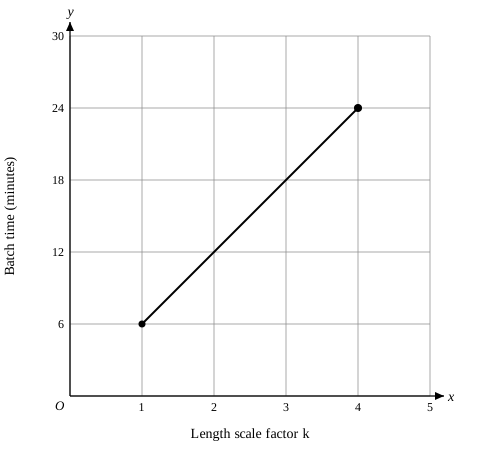
A coffee roaster uses similar square trays. The graph relates batch time to the factor multiplying each side length of a tray whose area is 105 square centimeters.
What is the area, in square centimeters, of the tray used for a 24-minute batch?
- A
- B
- C
- D
Show the answer
- A
This reports the original tray’s area, square centimeters, without enlarging it for the -minute batch.
- B
This comes from , multiplying the area by the length The number every length is multiplied by to turn one figure into a bigger or smaller copy of it.Read the lesson only once. Both side lengths are multiplied by , so the area scales by .
- CCorrect answer
The graph shows that a -minute batch uses a length The number every length is multiplied by to turn one figure into a bigger or smaller copy of it.Read the lesson of . The tray’s area is therefore square centimeters.
- D
This comes from , applying volume scaling to area. A square’s area scales by the square of the length factor.
Solution
Read the point on the graph: a batch time of minutes corresponds to .
Each side of the square tray is multiplied by . Since area is length times width, the area is multiplied by .
Multiply the original area by : square centimeters.
Practice
Before each one, say what the question wants, and check that your answer's unit matches it.
Next steps
Drills need a free account, which also saves your lesson progress on every device. Sign up free
Related lessons