What the questions look like
You get a figure, or a sentence describing one, and the last line often reads like one of these:
- “In the figure, line is parallel to line , and line intersects both lines. What is the value of ?”
- “In the triangle shown, . What is the value of ?”
- “What is the length of ?”, after a sentence saying which corners of two triangles match.
- “Which additional piece of information is sufficient to determine whether triangle is Exactly the same shape and size. to triangle ?”
Figures are drawn to scale unless a note under them says “Figure not drawn to scale.” Nearly every figure in these questions has that note, so go by the numbers and marks only. If a figure has no note, you can estimate from it, so if you get for an angle drawn wider than a square corner, recheck your work.
On scratch paper, copy the figure bigger, or draw it if there isn't one, and write every number from the question on it. Then fill in every angle you can get in one step. Desmos won't help here, since there's nothing to graph.
Two lines crossing
Two crossing lines make four angles. The two across from each other are The two angles across from each other where two lines cross. They are always equal., and they're always equal. Two angles side by side on one straight line are Two angles that add up to 180 degrees., which means they add to .
Copy the angle across from a given one. Subtract from 180° for the angle beside it.
- Right
- Across from 71°: 71°. Next to it on the line: 109°.
- Wrong
- Across from 71°: 109°.
Only the angle beside 71° shares the straight line with it.
Two angles that share an edge but don't sit on one straight line can add to anything.
Parallel lines and a line crossing them
A line that crosses two parallel lines is called a A line cutting across two parallel lines.. It cuts both at the same tilt, so the four angles at one crossing are copies of the four at the other.
That leaves only two sizes. If one angle is , each of the eight is or . Two small angles are equal, two big ones are equal, and a small one plus a big one is .
Questions may name the pairs, such as Angles in the matching position where a line crosses two others, such as both upper-right angles. When the two lines are parallel, they are equal..
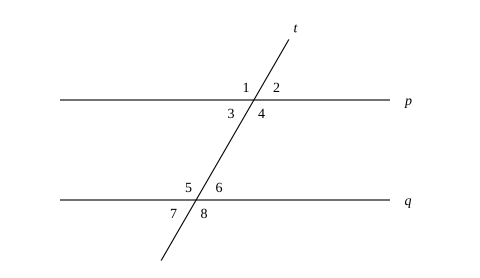
| Pair | Where they sit | Example | So |
|---|---|---|---|
| Corresponding | Same spot at each crossing | 2 and 6 | Equal |
| Alternate interior | Between the lines, opposite sides of the transversal | 3 and 6 | Equal |
| Alternate exterior | Outside the lines, opposite sides of the transversal | 1 and 8 | Equal |
| Same-side interior | Between the lines, same side of the transversal | 4 and 6 | Add to |
Trap: The supplement instead of the equal angle
With a angle given, the choices often include both 75 and 105. If the angle you want is the same size as the given one, 105 is the wrong choice. If one is small and the other big, 75 is.
What to do: Before you calculate, say whether the two angles are the same size or one small and one big.
Some questions run this backward and ask which fact proves two lines parallel. Equal corresponding angles do, and so do equal alternate interior angles, or same-side interior angles that add to . Next to a angle, a angle on the same line proves nothing, since that's true either way.
When the angles have letters
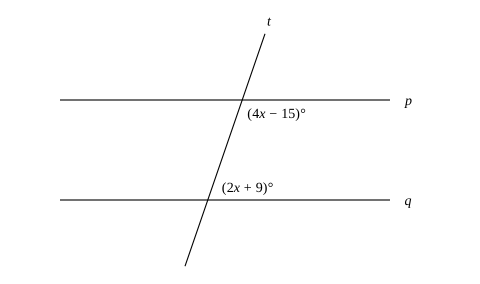
Lines and are parallel. The two labeled angles, and , sit between them, on the same side of , so one is big and one is small. The question asks for .
One big and one small angle add to .
Combine and .
Add 6 to both sides.
Divide both sides by 6.
The question asks for , so put in 31.
Trap: Setting them equal, or stopping at x
Setting the angles equal, , gives and a choice of 33. A choice of 31 is itself, and 71 is the other angle.
What to do: Decide equal or 180 from where the angles sit, and reread the last line before you answer.
If a second Two expressions set equal to each other, like 5x + 7 = 22.Read the lesson is printed under the figure, such as , and the question asks for , finish the geometry first. Then .
Harder versions ask about a total with no figure. A line crosses two parallel lines, so four angles are acute (under ) and four are obtuse. One acute angle is , and two acute angles plus three obtuse ones add to . What is ?
Try numbers first. If the acute angles were , the obtuse ones would be , and two acute plus three obtuse would be . That's 540 minus the acute angle.
Call the acute angle . Each obtuse angle is .
Multiply out, then .
Put in .
The minus sign flips both signs inside.
Add .
Match with .
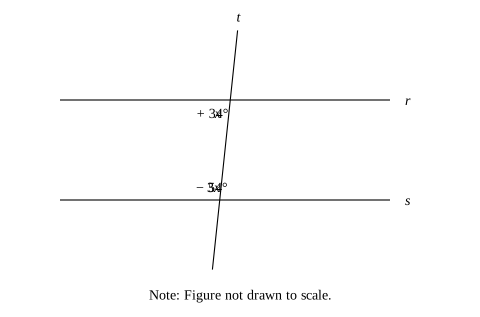
Reyes Nursery uses the alignment shown to position a divider above its compost-mixing bins.
In the figure, line is parallel to line , and line intersects both lines. What is the value of ?
- A
84
- B
78
- C
96
- D
50
Show the answer
- A
84
Correct answerThe labeled angles are same-side interior angles, so they are Two angles that add up to 180 degrees.Read the lesson. Solving gives , and therefore .
- B
78
This results from setting the same-side interior angles equal: . That Two expressions set equal to each other, like 5x + 7 = 22.Read the lesson gives and , but these angles are Two angles that add up to 180 degrees.Read the lesson, not equal.
- C
96
This results from solving for correctly and then subtracting the requested Numbers and letters combined with no equals sign, like 5x + 7.Read the lesson from . The value requested is , not its supplement .
- D
50
This is the value of alone. The question asks for , so you must add after finding .
Solution
The top lower-left angle and the bottom upper-left angle are same-side interior angles. Since and are parallel, these angles are Two angles that add up to 180 degrees.Read the lesson:
Combine Parts of an expression with the same letter raised to the same power, like 5x and 2x, which you can add together.Read the lesson and solve:
The question asks for , so substitute :
The angles in a triangle
The three angles in any triangle add to .
Subtract both known angles from 180°.
- Right
- Angles of 39° and 68° leave 180 − 39 − 68 = 73° for the third.
- Wrong
- The third angle is 180 − 68 = 112°.
Both known angles use up part of the 180°.
In a right triangle, the right angle takes , so the other two add to . Two angles that add to are Two angles that add up to 90 degrees..
The two smaller angles of a right triangle add to 90°.
- Right
- In a right triangle with a 32° angle, the third angle is 90 − 32 = 58°.
- Wrong
- The third angle is 180 − 32 = 148°.
The right angle has already used 90°.
Trap: Subtracting from 90 with no right angle
With angles of and , 22 comes from , in a triangle that never had a right angle.
What to do: Use 90 only when the figure has the small square or the question says right angle.
Two equal sides
An A triangle with two equal sides, which also has two equal angles. triangle has two equal sides. The two angles across from those sides, called the base angles, are equal too.
Find the angle between the equal sides before you split anything.
- Right
- and angle is 82°: angles and are each.
- Wrong
- and angle is 82°: angles and are each.
Angle sits between the equal sides, so it appears once. The two base angles split what's left.
The letters can fool you. With , the letter is in both names, so is the corner between the equal sides, and the equal angles are at and .
The angle across from a side is at the one corner that isn't on that side. Put tick marks on the equal sides, then mark the corner across from each one. Those two corners hold the equal angles.
- Right
- and angle is 37°: angle is 37°, and angle is .
- Wrong
- and angle is 37°: angle is 37°, and angle is 106°.
Angle is across from , and angle is across from . sits between the equal sides.
When all three sides are equal, the triangle is equilateral and every angle is . Three equal angles also mean three equal sides. Go by tick marks or numbers here, since even a figure drawn to scale can't show apart from .
A side extended past the triangle
“ is extended through to point ” puts past , outside the triangle. Draw , and on one line, in that order.
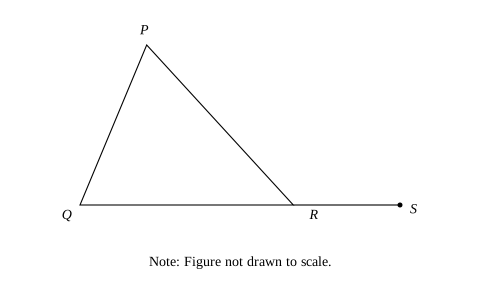
The outside angle and the inside angle at share a straight line. Take angle as and angle as .
The inside angle at .
Angle is beside it on the straight line.
Or add the inside angles at the other two corners, which is quicker.
An outside angle equals the two inside angles at the other corners added together.
- Right
- Angle .
- Wrong
- Angle .
Only the inside angle at , the same corner, adds with angle to 180°.
This one adds equal sides, with no figure.
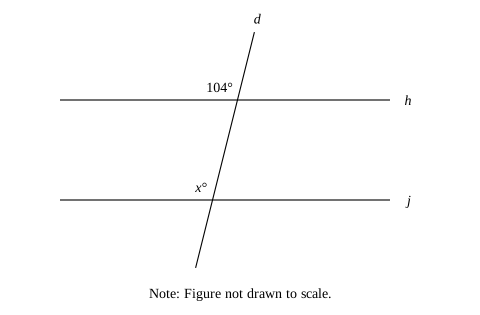
At a pencil factory, a guide for graphite cores is set with the alignment diagram shown, in which lines and are parallel. The guide also has a triangular outline , not shown, with . The outline’s interior angle at measures , where is the value labeled in the diagram. Side extends beyond to point .
What is the measure of , in degrees?
Show the answer
Accepted answers: 142, 142.0
Solution
The two upper-left angles in the alignment diagram are Angles in the matching position where a line crosses two others, such as both upper-right angles. When the two lines are parallel, they are equal.Read the lesson on parallel lines, so . Since , the base angles at and are equal. Each measures .
Because extends beyond to , angles and sum to . Thus, .
The wrong answer comes from subtracting the apex angle from , treating the remaining as one base angle, and taking its supplement. That remaining is the sum of both equal base angles.
The wrong answer comes from treating the apex angle as a base angle and taking its supplement. It can also come from taking the supplement of the apex angle when the requested exterior angle is at .
Similar triangles
Triangles with the same angles, so one is a bigger or smaller copy of the other with every side multiplied by the same number. are the same shape in different sizes. Their matching angles are equal, and each side of one is the same number times the matching side of the other. That number is the The number every length is multiplied by to turn one figure into a bigger or smaller copy of it.. Two pairs of equal angles are enough to make two triangles similar. A triangle “dilated by a scale factor of 3” gives a similar one with every side 3 times as long.
Say triangle is similar to triangle , with and , and angle is . The scale factor is , and a question might write that as .
Copy a matching angle across unchanged.
- Right
- Angle is 56°.
- Wrong
- Angle is .
The scale factor stretches sides and leaves angles alone. No triangle has an angle over 180°.
The order of the letters tells you which corners match. “Triangle is similar to triangle ” means matches , matches , and matches . So matches , and matches . Take , and , and find .
Triangle 's side on top in both fractions.
Fill in the lengths.
Cross-multiply: .
Divide both sides by 24.
Trap: One fraction flipped
gives , shorter than , though is the bigger triangle.
What to do: Write the two triangles' letters in two rows, and keep the same triangle on top in both fractions.
If two matching sides add to 100 and the scale factor is 4, the sides are and , so , , and the long side is 80.
Two crossing segments make a bow tie of two triangles. If and cross at and angle equals angle , the vertical angles at make triangle similar to triangle . So matches , on a different segment. Write over before you pair sides.
A smaller triangle inside a larger one
In triangle , is on side , is on side , and is parallel to .
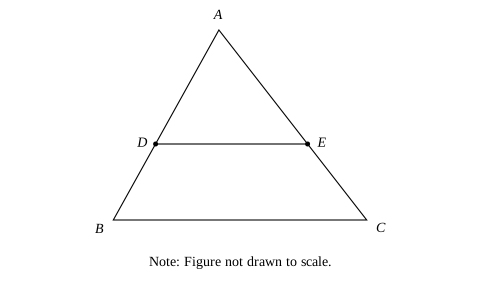
The parallel line cuts off a small triangle that's similar to the whole triangle . Say , and . Find .
Small triangle on top, whole triangle below, both sides starting at .
Fill in the lengths.
Multiply both sides by 54.
, and .
Compare the small triangle's side with the whole matching side of the big one.
- Right
- Wrong
is the leftover piece of and belongs to neither triangle. With , it gives , longer than .
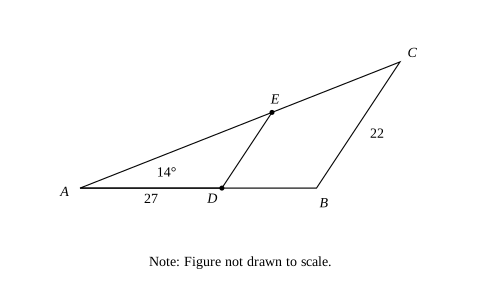
Solveig plots a rain gauge’s weekly totals on the triangular panel shown for the station’s field log. , and .
What is the length of ?
- A
8.4
- B
13.2
- C
33
- D
Show the answer
- A
8.4
This applies the The number every length is multiplied by to turn one figure into a bigger or smaller copy of it.Read the lesson to the angle, giving . Similarity preserves angle measures; the scale factor applies to corresponding side lengths.
- B
13.2
Correct answerBecause , triangles and are similar. Their The number every length is multiplied by to turn one figure into a bigger or smaller copy of it.Read the lesson is , so .
- C
33
This uses as the The number every length is multiplied by to turn one figure into a bigger or smaller copy of it.Read the lesson. The similarity A comparison of two amounts, like 3 to 5.Read the lesson must compare corresponding whole sides, so corresponds to , not to the leftover segment .
- D
This inverts the similarity A comparison of two amounts, like 3 to 5.Read the lesson to . That produces a value longer than , even though is the corresponding side of the smaller triangle.
Solution
Since , Angles in the matching position where a line crosses two others, such as both upper-right angles. When the two lines are parallel, they are equal.Read the lesson are equal, so .
The corresponding sides are and , and and . Set up the Two ratios set equal to each other, which you can solve for a missing number.Read the lesson Substitute the given lengths: Therefore,
What the scale factor does to area
If the scale factor is , every length grows by , and area grows by .
Multiply an area by the square of the scale factor.
- Right
- Area 20, sides 2.5 times as long: the new area is .
- Wrong
- Area 20, sides 2.5 times as long: the new area is .
The base and the height both grow by 2.5, so the area grows by 2.5 twice.
Harder questions make you find a missing side first, often with the Pythagorean theorem, which the right triangles lesson covers. The long side across from a right angle is the The longest side of a right triangle, the one opposite the right angle.Read the lesson.
In triangle , is on and is on , with parallel to . Angles and are right angles. , and . What is the area of triangle ?
, since is the hypotenuse.
Take the square root.
is both pieces, 12, so the scale factor is .
The other leg grows by too.
Area is half of base times height.
Trap: A half-finished area scaled
The small triangle's area is . A choice of 30 multiplies it by 3 instead of .
What to do: Find the lengths first. Then use on lengths and on areas.
An amount that goes with length, such as The distance all the way around a flat shape.Read the lesson or a fence's cost, grows by once. A $50 fence around a triangle with sides 6, 8 and 11 has a similar twin with long side 44, so and the twin's fence costs $200. Using would give $800.
Proving two triangles match
Congruent triangles are the same shape and size, so every matching side and angle is equal. If triangles and are congruent, with matching , right angles at and , and angle at , then angle matches angle , which is .
Other questions ask which extra fact is “sufficient to determine” that two triangles are similar or congruent. Sufficient means enough to prove it.
To prove two triangles similar, you need two pairs of equal angles. Find the third angle first. Triangle with at and at has left, so it's similar to triangle with at and at . Two pairs of sides in the same A comparison of two amounts, like 3 to 5.Read the lesson also work, but only if the angles between those sides are equal. If the equal angles sit anywhere else, the sides prove nothing.
To prove them congruent, the sizes have to match too. Below, S means a pair of equal sides and A a pair of equal angles.
| Test | What has to be equal |
|---|---|
| SSS | Three pairs of sides |
| SAS | Two pairs of sides and the angles between them |
| ASA | Two pairs of angles and the sides between them |
| AAS | Two pairs of angles and another pair of sides |
| HL | In right triangles, the hypotenuses and one pair of legs |
Two sides with an angle that isn't between them (SSA) proves nothing.
Equal angles can't show equal sizes, so which fact would make triangles and above congruent?
Congruent needs one pair of matching sides shown equal. Match sides by the angles at their two ends.
- Right
- .
- Wrong
- .
runs between the 40° and 75° angles. In triangle the 75° angle is at , so the matching side is .
With statements I and II, test each one alone with the facts you were given, then both together. “No additional information is needed” is right when those facts already prove it, such as two equal angle pairs on a question about similar triangles.
Practice
Before you calculate, say which relationship you're using. When you're done, check your answer against the last line of the question.
Next steps
Drills need a free account, which also saves your lesson progress on every device. Sign up free
Related lessons