What the questions look like
Look for the small square that marks a right angle. With no figure, the words can still give you one, like a ladder leaning on a wall or a walk due east and then due north.
The last line usually reads like one of these:
- “Which of the following is closest to the length of the triangle's hypotenuse?”
- “In the triangle shown, what is the value of ?”
- “What is the value of ?”
The two sides that meet at the right angle are the legs. The hypotenuse is across from the right angle, and it's always the longest side. If there's no figure, draw one on scratch paper and write every number on it.
A figure is drawn to scale unless it says “Note: Figure not drawn to scale.” When a figure has that note, use only the numbers.
Finding a missing side
Pythagorean theorem
, where and are the legs and is the hypotenuse
It's on the The page of formulas you can open at any point in the Math section.Read the lesson. Say the legs are 5 and 8.
Square each leg and add.
Work out the squares.
Take the square root last.
Add the squares of the legs to get the hypotenuse.
- Right
- Legs 5 and 8: .
- Wrong
- Legs 5 and 8: .
comes from . It's shorter than the leg of 8, and the hypotenuse has to be the longest side.
Trap: Adding the legs
13 is . It's a clean whole number, so it looks finished.
What to do: Square first and take the square root last. The hypotenuse is always less than the two legs added together.
To find a leg, subtract the leg's square from the hypotenuse's square. Say the hypotenuse is 75 and one leg is 21.
The hypotenuse's square comes first.
Work out the squares.
.
Trap: The hypotenuse used as a leg
adds the squares when a leg was wanted, so the leg comes out longer than the hypotenuse.
What to do: Before you add or subtract, find the side across from the right angle. It has to come out longest.
Learn 3-4-5, 5-12-13, 8-15-17 and 7-24-25 by sight, and their multiples, like 6-8-10.
- Do this
- Check whether the sides are a multiple of a triple you know.
- Not this
- Square big numbers by hand before you look for a pattern.
75 is 25 times 3 and 21 is 7 times 3, so the other leg is 24 times 3, or 72.
Some choices are Two expressions set equal to each other, like 5x + 7 = 22.Read the lesson. If the legs are 7 and and the hypotenuse is 12, the equation is . A choice like treats 12 as a leg.
For a “closest to” question, type sqrt in Desmos, then 5^2+8^2. It shows about 9.434.
When a side has a square root in it
Square a side like one piece at a time. Say the legs are and 5.
Square the 2 and square the root.
Squaring a square root just removes it.
Add the other leg's square, 25.
.
Square the number in front of the root as well as the root.
- Right
- Wrong
12 is . The 2 in front of the root has to be squared too.
Trap: A square root half squared
comes from , with the 2 left unsquared. And treats as .
What to do: Square the number in front and the root separately. Never split a square root across a plus sign.
Some choices write a length as a number times a square root. Pull the biggest square number out from under the root. Legs 6 and 12 give , and , so the hypotenuse is .
A right triangle inside a rectangle
A diagonal cuts a rectangle into two right triangles. The rectangle's sides are the legs, and the diagonal is the hypotenuse.
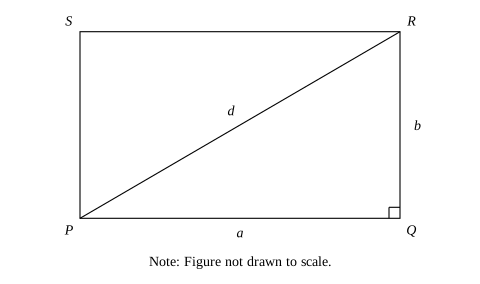
If a rectangle's corners all sit on a circle, its diagonal is a The distance straight across a circle through the center, which is twice the radius.Read the lesson. A rectangle 9 by 12 has diagonal 15, so that circle's The distance from the center of a circle out to its edge.Read the lesson is 7.5.
When one side is described using the other, call the shorter side . A rectangular garden has a diagonal path 26 meters long, and its length is 14 meters more than its width. What's the garden's area?
Width , length , diagonal 26.
Multiply out . And .
Add the terms and subtract 676 from both sides.
Divide every term by 2.
24 and multiply to and add to 14.
A width can't be .
The length is . Multiply for the area.
The area is 240 square meters.
Trap: Squaring halfway
for drops the middle term, . That leads to and a width of about 15.5.
What to do: Write as and multiply out every part.
In Desmos, type x^2+(x+14)^2=676. It draws a vertical line at each solution. Click where the right-hand line crosses the horizontal One of the two lines a graph is measured against, one running across and one running up. to read 10.
Now try one where the diagonal has a square root in it.
Beneath a cafe’s bean grinder, a rectangular mat has diagonal inches and length 6 inches greater than width.
What is the length, in inches, of the mat?
Show the answer
Accepted answers: 15, 15.0, 15/1
Solution
Let be the width in inches. The length is . The sides and diagonal form a right triangle, so the Pythagorean theorem gives .
Expand and simplify: , so . Factoring gives . The width must be positive, so . The length is inches.
The wrong answer comes from setting the sum of the legs equal to the diagonal: . The Pythagorean theorem relates the squares of these lengths, not their sum.
The wrong answer reports the width. The question asks for the length, which is inches greater.
The wrong answer comes from incorrectly squaring as instead of . Using in the Pythagorean Two expressions set equal to each other, like 5x + 7 = 22.Read the lesson produces a length of approximately inches.
Sine, cosine and tangent
Stand at the angle the question names. The leg across from it is the opposite side, and the leg touching it is the adjacent side. The hypotenuse doesn't change.
SOH CAH TOA
SOH CAH TOA is how you remember it. Sine is Opposite over Hypotenuse, Cosine is Adjacent over Hypotenuse, and Tangent is Opposite over Adjacent.
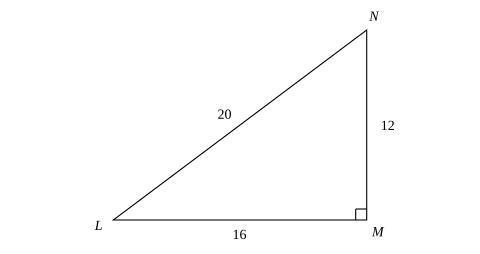
Here the right angle is at , , and . Standing at , is opposite and is adjacent. So and .
On scratch paper, write opposite, adjacent or hypotenuse next to each number before you divide.
- Right
- Wrong
Tangent is opposite over adjacent. From , the opposite side is .
Standing at , the legs trade jobs. is now opposite, so .
Trap: The ratio from the other corner
is a choice when the question asks for . It's the tangent at , and it's upside down. And is a choice for , because it's .
What to do: Sketch the triangle on scratch paper, mark the angle the question names, and draw an arrow straight across from it. The side the arrow hits is the opposite side.
Don't reduce a A comparison of two amounts, like 3 to 5.Read the lesson unless the choices do. If a question gives and asks for the hypotenuse , it's 20. Reducing to first would give 5.
For an acute angle, sine and cosine are always between 0 and 1. Tangent is more than 1 whenever the opposite leg is longer than the adjacent one.
- Right
- A cosine of is possible.
- Wrong
- A cosine of is possible.
A leg is always shorter than the hypotenuse, so a leg over the hypotenuse is less than 1.
When the side you need is missing
Say a right triangle has legs 20 and 99, and the question asks for , where is the angle across from the 20.
Sine needs the hypotenuse, so find it.
.
Opposite over hypotenuse.
is the tangent, and is the cosine. You can answer from the sides without ever finding the angle.
This next one gives you the hypotenuse instead, so you subtract to find a leg first.
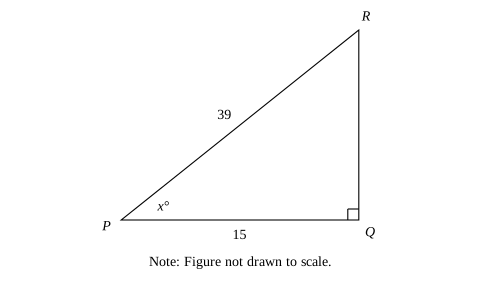
Blessing records the triangular route shown in her log.
In the triangle shown, what is the value of ?
- A
- B
- C
- D
Show the answer
- A
This reverses the tangent A comparison of two amounts, like 3 to 5.Read the lesson by dividing the adjacent leg, , by the opposite leg, , giving .
- B
This treats the The longest side of a right triangle, the one opposite the right angle.Read the lesson, , as a leg and calculates the missing side using . Dividing that result by gives .
- C
This treats the The longest side of a right triangle, the one opposite the right angle.Read the lesson, , as the side opposite angle , giving .
- DCorrect answer
Use the Pythagorean theorem to find the opposite leg: . Therefore, .
Solution
The side adjacent to angle is , and the The longest side of a right triangle, the one opposite the right angle.Read the lesson is . Let the opposite leg be . The Pythagorean theorem gives , so and . Tangent is the A comparison of two amounts, like 3 to 5.Read the lesson of the opposite leg to the adjacent leg. Thus, .
The two special right triangles
These two side patterns are on the reference sheet.
Special right triangles
--: . --: .
A 45-45-90 triangle is half a square. With legs of 7, the hypotenuse is and the The distance all the way around a flat shape.Read the lesson is . Every 45-45-90 perimeter has two parts like that, one equal to the other times , and the smaller part is the hypotenuse. Here that's , about 9.9.
A 30-60-90 triangle is half an equilateral triangle. The short leg is across from , the long leg is across from , and the hypotenuse is .
Match each side to the angle across from it.
- Right
- Hypotenuse 18: the leg across from is 9, and the leg across from is .
- Wrong
- Hypotenuse 18: the leg across from is , and the leg across from is 9.
The shortest side is across from the smallest angle. is about 15.6, longer than 9.
An equilateral triangle's height splits it into two of these. With sides of 10, each half has hypotenuse 10 and short leg 5, so the height is .
Trap: The special triangle misremembered
A height of for that triangle uses the whole side as the short leg. A choice off by a factor of , or 2 comes from a side matched to the wrong angle.
What to do: Copy the reference-sheet triangle onto scratch paper and label each side with the angle across from it.
Use SOH CAH TOA on these sides to get the values.
| Angle | Sine | Cosine |
|---|---|---|
The tangents are , , and .
To check one in Desmos, switch to Degrees first. Then tan(60) gives about 1.732, which is .
Trap: Desmos set to radians
Desmos starts in A unit for measuring angles in which a full circle is 2 pi, the same as 360 degrees.Read the lesson, so sin(30) gives about . The sine of is 0.5.
What to do: For an angle in degrees, open the wrench at the top right of the graph and switch to Degrees. The setting stays when you move on, so switch back to Radians before you type an angle with in it.
Similar right triangles
Triangles with the same angles, so one is a bigger or smaller copy of the other with every side multiplied by the same number.Read the lesson have the same angles, so matching angles have the same sine, cosine and tangent at any size. The lines, angles, and triangles lesson shows how to tell which corners match.
Say triangle is similar to triangle , with matching and right angles at and , and .
The The number every length is multiplied by to turn one figure into a bigger or smaller copy of it.Read the lesson changes the sides and leaves every ratio alone.
- Right
- 's sides are 3 times as long, and .
- Wrong
- 's sides are 3 times as long, so .
Both sides in the ratio are 3 times as long, so the fraction is , which is still .
The question may ask about the other acute angle, , which matches . The side across from touches , so , and so is . For , find the third side first. It's , so .
Build the triangle from a ratio
A ratio gives you a triangle's shape but not its size. means the adjacent side and the hypotenuse are 5 parts and 13 parts, so call them and . Another fact, like the perimeter, tells you .
In right triangle , the right angle is at , , and the perimeter is 90. How long is ?
is across from the right angle. touches .
Subtract to find the third side.
Square the number and the in each.
Take the square root.
Add the three sides for the perimeter.
Divide both sides by 30.
Put back in.
Trap: The ratio read as the sides
13 treats as if the hypotenuse were exactly 13. That triangle's perimeter is only 30.
What to do: Put on every side until another fact gives you its value.
The figure might label the sides with a letter instead. Say the opposite side is , the adjacent side is , and .
Opposite over adjacent.
Cross-multiply.
Multiply out the 3.
Subtract from both sides.
When sine equals cosine
Go back to the triangle with sides 12, 16 and 20. The side across from touches , so and are both . Angles and add to , which makes them Two angles that add up to 90 degrees.Read the lesson. The sine of an acute angle always equals the cosine of its complement.
When the sine of one acute angle equals the cosine of another, add their measures and set the sum equal to 90.
- Right
- Acute angles and with add to .
- Wrong
- Acute angles and with are equal.
Like and above, they fit together as the two acute angles of one right triangle.
Say acute angles and have . Angle measures and angle measures . What's the measure of the smaller angle?
The angles add to .
Add the terms and the numbers.
Subtract 6, then divide by 6.
Put 14 into the first measure.
And into the second. , so it checks.
The smaller angle is .
Trap: The angles set equal
30 comes from setting , which gives two angles. A sum of 180 gives a angle, which isn't acute. And 14 is , while 50 is the larger angle.
What to do: When you're done, check that both angles are between and , then reread which one the question wants.
In Desmos, type (4x-6)+(2x+12)=90, with for , and click where the vertical line crosses the axis.
If the angles are in radians, they add to instead, since is radians.
Now try one that asks for the larger angle.
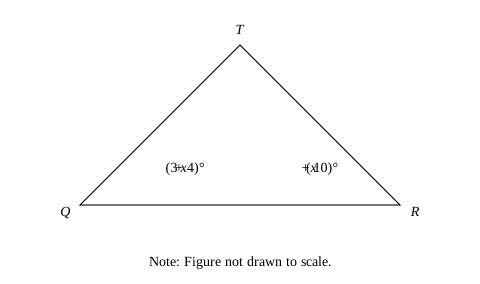
In triangle , the measure of angle is and the measure of angle is . Angles and are acute, and .
What is the measure, in degrees, of the larger of angles and ?
- A
- B
- C
- D
Show the answer
- A
Because , the third angle, , measures . The question asks for the larger of angles and , not angle .
- BCorrect answer
Since and are acute, gives . Thus , so . The angles measure and , so the larger angle measures .
- C
When , angle measures , which is the smaller of the two angles. The question asks for the larger angle, .
- D
This comes from setting , which gives and an angle of . For acute angles, means , not .
Solution
The complementary-angle identity gives . Since both angles are acute, implies , so .
Substitute the angle Numbers and letters combined with no equals sign, like 5x + 7.Read the lesson: . Combine terms to get , then , so .
The angle measures are and . The larger angle measures .
Sine and cosine in one expression
Some questions give an Numbers and letters combined with no equals sign, like 5x + 7.Read the lesson with the sine and cosine of two complementary angles and ask which choice is equal to it. You need one more fact. For any angle , , which you'll also see written .
Start. .
The sine of an angle is the cosine of its complement.
Swap it in, so one angle is left.
Sine squared plus cosine squared.
The right choice might not say 1. It can be any expression with the same value, like , so rewrite each choice the same way until one matches.
Trap: A sine left as a sine
comes from rewriting as . It's about 0.66.
What to do: Every swap to the complement turns sine into cosine or cosine into sine.
Give the answer the question asks for
On a A question where you type your own answer instead of picking one of four.Read the lesson, you can enter as 7/9, .7777 or .7778. Type 7/9 in Desmos to see the decimal. You can't enter a square root in the box.
In a story, write down the length you found with its units, then finish the rest, like a cost per mile. A count of how many things fit rounds down.
Before you pick, reread the last line. It might want the other angle, or a total built from the length you found.
Practice
Before each one, find the right angle and say what the question wants.
Next steps
Drills need a free account, which also saves your lesson progress on every device. Sign up free
Related lessons