What the questions look like
You can tell which kind of circle question you have before you do any math.
- An equation with both and . The question asks “What are the coordinates of the center?”, “What is the length of the radius of this circle?” or “Which equation represents this circle?”
- A circle with an angle or a length marked on it. These ask for an arc, an angle, or the The distance all the way around a circle.Read the lesson.
- An angle written with in it, like .
- A line that's tangent to the circle, which means it touches the circle at one point without crossing it.
Most of these put a near miss among the choices, like the The distance straight across a circle through the center, which is twice the radius.Read the lesson when the question asks for the radius. Before you pick, read the last line again.
Center and radius
Circle equation
The center is and the radius is . Since the form subtracts the center's coordinates, means .
Flip the sign of each number in the parentheses to get the center.
- Right
- has center .
- Wrong
- has center .
Each sign you see is the opposite of the coordinate.
Trap: Signs copied from the parentheses
For , the choice keeps the printed signs. The center is .
What to do: Ask what value makes each parenthesis zero. when .
The number on the right is the radius squared. It's sitting right there on the page, so it's easy to copy down as the radius.
Take the square root of the right side to get the radius.
- Right
- has radius .
- Wrong
- has radius .
The right side is , and .
A diameter goes straight across through the center, so it's twice the radius.
Trap: Half or double the length asked for
has radius 9 and diameter 18, and 9 is the wrong choice when the question asks for the diameter. A story might call the diameter the width of a round table.
What to do: Before you start, say whether the question asks for the radius or the diameter. A length that runs all the way across through the center is a diameter, even if the question never says so.
Writing the equation
To write the equation, flip the center's signs and square the radius. Center and radius 11 give . With a radius of , square the number and the letter.
Square the whole radius.
Square the 11 and square the .
Flip the center's signs.
Trap: The radius squared halfway
The choices ending in and each square only one part, and doesn't square at all.
What to do: Write the whole radius in parentheses, , before you look at the choices.
Some questions keep the center and change the size. Say a circle has the same center as and a radius three times as long.
Find the first radius.
Triple it.
Square the new radius: .
A choice of 48 comes from tripling the right side, but tripling the radius multiplies the right side by .
If you get the center and a point on the circle, the radius is the long side of a right triangle between them. Take center and point .
How far across and how far up.
Square both legs and add.
The equation needs , so there's no square root to take.
Given the two ends of a diameter, the center is halfway between them. Ends and give center . They're 8 apart, so the radius is 4.
Completing the square
When there's a loose or term, like the in , you have to rebuild the squares before you can read the center.
Start with a square you know. , a An expression that equals something times itself, like x squared plus 6x plus 9, which is (x + 3) times (x + 3).Read the lesson. The 6 is twice 3, and the 9 is 3 squared. So to finish , take half of 6 and add its square, 9.
Group the terms and the terms.
Halve the number with and square it.
Do the same for .
Add 16 and 49 to both sides: .
Write each group as a square, using the halves.
The center is and the radius is 10.
Trap: Completing the square halfway
A radius of comes from adding 16 and 49 on the left only. A center of keeps the signs from and .
What to do: Write every number you add on both sides of the equals sign.
Leave a A letter that stands for a number you don’t know yet, like the x in 5x + 7.Read the lesson that's already squared, like , alone. If the number with is odd, half of it is a fraction. For , half of 3 is , so add . And some questions run it backward, asking for in . For the circle above, multiply out and subtract 100 from both sides to get , so .
Check a center
- Type
x^2+y^2+8x-14y=35. Desmos draws the circle with no completing the square. - Type
(-4,7)on the next line. The dot should sit in the middle of the circle. - Count gridlines from the dot to the edge to check the radius.
What are the center and radius of the circle defined by the given equation?
- A
The center is , and the radius is .
- B
The center is , and the radius is .
- C
The center is , and the radius is .
- D
The center is , and the radius is .
Show the answer
- A
The center is , and the radius is .
This results from adding and only to the left side and leaving on the right. That error makes the The distance from the center of a circle out to its edge.Read the lesson appear to be .
- B
The center is , and the radius is .
This copies the signs from and directly into the center. The center coordinates use the opposite signs, giving .
- C
The center is , and the radius is .
Correct answerCompleting the square gives . In the form , the center is and the The distance from the center of a circle out to its edge.Read the lesson is .
- D
The center is , and the radius is .
This reports the completed right side, , as the The distance from the center of a circle out to its edge.Read the lesson. Since , the radius is .
Solution
Group the -terms and -terms:
. Complete each square. Add and to both sides:
. Factor the perfect-square trinomials:
. Compare this with . The center is , and , so the The distance from the center of a circle out to its edge.Read the lesson is .
Moving a circle
Moving a circle changes the center and nothing else, so the right side stays. Here's moved down 7.
Read the center.
Down 7 subtracts 7 from the -coordinate.
Flip the signs back. The right side stays.
Up adds to the -coordinate and down subtracts. Right and left do the same to .
Trap: The shift goes the wrong way
puts the center at , which moved up. moved right instead of down, and a choice that changes 64 resized the circle.
What to do: Move the center on paper first, then build the equation from the new center.
Some questions write the moved circle with right side and ask for something like . The radius didn't change, so and .
On a barn floor plan, distances are measured in feet. A hay bale stack has a circular boundary modeled by , where and is a positive constant. The stack is moved 6 feet to the right without changing its shape or size.
Which equation represents the relocated stack's boundary?
- A
- B
- C
- D
Show the answer
- A
Subtracting from gives , which moves the center left. A move to the right increases the center's -coordinate.
- B
The Numbers and letters combined with no equals sign, like 5x + 7.Read the lesson squares but leaves the The number multiplying a letter, like the 5 in 5x.Read the lesson unsquared. Squaring both factors gives .
- CCorrect answer
Moving the stack feet right changes its center from to . The The distance from the center of a circle out to its edge.Read the lesson stays , so the relocated boundary is .
- D
Writing the positive center coordinates as plus signs inside the parentheses reverses their signs: has center . For the center , subtract each coordinate inside its parentheses.
Solution
A circle with center and The distance from the center of a circle out to its edge.Read the lesson has Two expressions set equal to each other, like 5x + 7 = 22.Read the lesson . The original center is .
Moving feet right adds to the center's -coordinate and leaves its -coordinate unchanged. The new center is .
The stack's size stays the same, so its radius remains , and . Substituting the new center and squared radius gives .
Which points can be on the circle
Every point is within one radius of the center, so runs from to . The question reads “The point lies on the circle. Which of the following is NOT a possible value of ?” Take .
Read the circle: .
The leftmost and rightmost .
So can be anything from to 15, ends included. Out of , , 3 and 15, only is impossible.
The same idea shows when a circle touches an One of the two lines a graph is measured against, one running across and one running up. once. has its leftmost point at , so it just touches the -axis.
Arcs and central angles
An arc is a piece of the circle's edge between two points. Two points cut the edge into two arcs. The shorter one is the The shorter of the two arcs between two points on a circle. and the longer one is the The longer of the two arcs between two points on a circle.. A An angle with its corner at the center of a circle and its two sides reaching the edge. has its corner at the center.
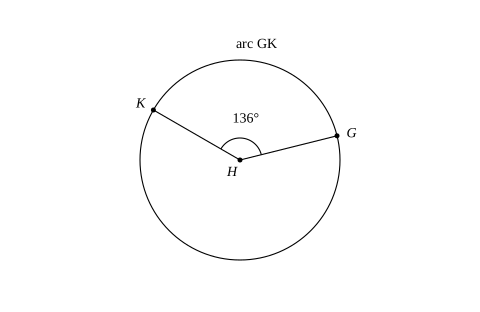
Angle is , so arc measures too. Some questions ask only that. If arc is and is the center, angle is .
An arc's degree measure is its central angle. Its length is a separate number, in units like centimeters.
- Right
- Arc is 28 centimeters long, and its measure is .
- Wrong
- Arc is 28 centimeters long, and its measure is .
The length depends on the circle's size. The degrees come from the central angle.
Some questions ask for an angle of triangle , which you get by drawing the segment from to . Two of its sides are radii, so they're the same length. That makes the triangle A triangle with two equal sides, which also has two equal angles.Read the lesson, and its angles at and are equal. Say the central angle is .
A triangle's angles add to .
Split it between the equal angles at and .
Arc length
The The page of formulas you can open at any point in the Math section.Read the lesson gives and . Since a diameter is , as well. The arc rule isn't on the sheet. An arc is the same fraction of the circumference as its angle is of .
Arc length
An arc is inches long with a central angle of . What's the radius?
Fill in the arc and the angle, and simplify.
The whole circle is 10 times the arc.
Divide by .
Trap: The wrong whole circle
Using 180 gives a radius of 12.5, half the real one. 50 divides by alone, which is the diameter. And is , the area.
What to do: Put 360 under the angle every time, and divide the circumference by .
A story might set the arc on a dial or a ring. The two points named on the edge and the center still make a central angle, and the same Two ratios set equal to each other, which you can solve for a missing number.Read the lesson works. Desmos can't set it up for you.
A scrapyard’s circular metal weight has an arc measuring centimeters with a central angle of .
What is the length of the radius, , in centimeters?
Show the answer
Accepted answer: 58
Solution
A full circle measures , so the A piece of a circle's edge between two points on it.Read the lesson is of the The distance all the way around a circle.Read the lesson. The circumference is therefore centimeters.
Use : , so centimeters.
The response reports the The distance straight across a circle through the center, which is twice the radius.Read the lesson as the The distance from the center of a circle out to its edge.Read the lesson. Dividing the circumference by without also dividing by produces this error.
The response comes from using as the whole-circle angle. That makes the arc half the circumference and gives , half the correct radius.
Arcs that make up the whole circle
The minor and major arcs between two points add up to the circumference, and their degrees add up to .
- Right
- Minor arc 52 cm, major arc 164 cm: circumference 216 cm.
- Wrong
- Minor arc 52 cm, major arc 164 cm: circumference 112 cm.
Together the two arcs go all the way around, so add them.
Two diameters cut the circle into four arcs. Arcs across from each other match, because the angles across from each other at the center are equal (The two angles across from each other where two lines cross. They are always equal.Read the lesson, from the lines, angles, and triangles lesson).
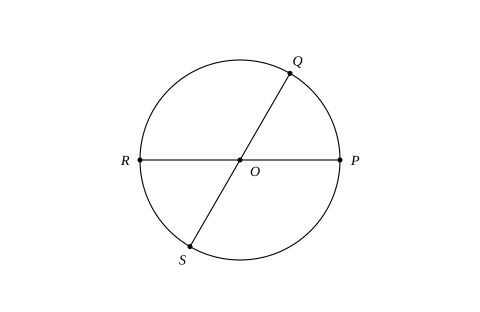
The circumference is , and arc is longer than arc . How long is arc ?
Call arc . Arcs and make half the circle, and half of is .
Combine the terms and subtract .
Divide by 2.
Arc is across the center from arc .
Radians and degrees
A full circle is , or radians, and the reference sheet gives both. Halve them and radians. To change radians to degrees, multiply by . For degrees to radians, use .
Leaving radians, so goes on the bottom.
The two s cancel.
, and .
Trap: The conversion upside down
leaves on top. Using 360 for 180 doubles the answer to .
What to do: Check that the cancels.
The question may never say radians. An angle with and no degree sign is in radians. If a dial turns and the choices are Numbers and letters combined with no equals sign, like 5x + 7.Read the lesson, pick without working it out.
Sine and cosine repeat every full turn, or , so you can drop full turns from a big angle. Here's .
Write a full turn over 4.
That's 12 full turns with left over.
Drop the turns. is .
Desmos starts in radians, so you can check it there. Since , type sin(24.25pi). It prints about 0.707, which is . If you switched to Degrees in the wrench menu for a triangle question, switch back first.
Tangent lines
The radius to the point where a tangent touches meets the tangent at a right angle. Draw that radius first.
Since the lines are perpendicular, the tangent's How steep a line is, measured by how much it goes up for each unit it moves to the right.Read the lesson is the radius's slope flipped with its sign changed. Center , tangent at :
Slope of the radius.
Flip it and change the sign.
Check: perpendicular slopes multiply to .
Trap: Half the flip
is the radius's own slope. flips without changing the sign, and changes the sign without flipping.
What to do: Do both moves, then multiply the slopes to check for .
From a point outside, the two tangent segments are the same length. Each makes a right triangle with a radius, and the line to the center is the long side.
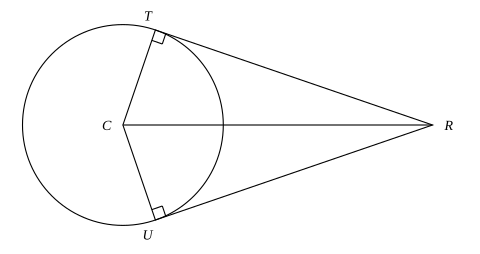
In the figure, the center is , and the tangents from touch the circle at and . Say the radius is 12, and quadrilateral , the four-sided shape they make, has a The distance all the way around a flat shape.Read the lesson of 94. Find .
Take the two radii off the perimeter.
The two tangent segments are equal.
Right triangle with legs 12 and 35.
Take the square root.
Trap: The wrong triangle
47 adds 12 and 35 without squaring. uses the diameter, 24, as a leg.
What to do: Sketch it. The radius and the tangent segment are the legs, and both get squared.
If a question asks for the area of , it's two of those triangles: . More on right triangles is in right triangles and trigonometry.
Practice
Before each one, decide which kind it is: an equation, an arc, an angle with , or a tangent.
Next steps
Drills need a free account, which also saves your lesson progress on every device. Sign up free
Related lessons