What the questions look like
An inequality compares two amounts with , , or .
Read the last line first. It might say:
- “Which inequality represents this situation?”
- “What is the greatest number of shirts the club can order without exceeding its budget?”
- “Which point is a solution to the given system of inequalities in the -plane?”
- “For which of the following tables are all the values of and their corresponding values of solutions to the given inequality?”
- “The shaded region shown represents the solutions to which inequality?”
- “Which statement is the best interpretation of in this context?”
Inequality choices often share every number and differ only in the sign or in which price goes with which letter, so look at what changes.
Leave Desmos closed when the question only asks which sign to use or what a number means.
Solving a budget question
A club is ordering printed T-shirts. The shop charges an $18 setup fee plus $4.75 per shirt, and the club can spend no more than $250. What is the greatest number of shirts the club can order?
Name the letter and what it counts.
Build the total cost. The $18 is paid once, and $4.75 is paid for each shirt.
“No more than $250” lets the total equal 250 but not go over, so use .
Subtract 18 from both sides. The sign stays the same.
Divide both sides by 4.75. It's positive, so the sign still stays.
Round down. The money runs out before shirt 49.
Check 48 in the original cost. $246 fits in $250.
Check one more. 49 shirts go over, so 48 is the answer.
On a A question where you type your own answer instead of picking one of four.Read the lesson, you'd enter 48.
Here's one to try.
Elif manages sole stock at a neighborhood shoe repair. To prepare for the next 4 weeks, she will order identical pairs of replacement soles from a supplier. The supplier charges a one-time delivery fee of $7.70 plus $3.40 for each pair of soles. Elif can spend no more than $227.00 on the order, including the delivery fee.
What is the greatest number of pairs of replacement soles Elif can order without exceeding the budget?
Show the answer
Accepted answer: 64
Solution
Let be the number of pairs. The total cost is the one-time delivery fee plus the charge per pair, so . Subtract :
. Divide by :
. Only whole pairs can be ordered, so the greatest possible number is . The cost of pairs is , which is within the budget. A common wrong answer is , which comes from rounding up even though pairs would cost , exceeding the budget. Another common wrong answer is , which comes from multiplying the one-time delivery fee by the number of pairs and treating as a fixed charge.
Which sign the words give
| Words | Sign |
|---|---|
| At least, no fewer than, minimum | |
| At most, no more than, maximum, cannot exceed, up to | |
| More than, over, exceeds | |
| Less than, under, below |
“At least” and “at most” include the number itself. “More than” and “less than” leave it out, and an inequality that leaves it out is a An inequality that uses less than or greater than without “or equal to,” so the boundary value itself doesn’t count., written with or .
Decide whether the boundary number counts before you solve.
- Right
- A petition has 29 signatures and needs at least 40, so 11 more is enough.
- Wrong
- A petition has 29 signatures and needs at least 40, so it needs 12 more.
gives . Eleven more makes exactly 40, and “at least 40” lets 40 count.
Trap: The sign points the wrong way
The T-shirt order was an $18 setup fee plus $4.75 a shirt, with no more than $250 to spend. has every number in place, but it says the club has to spend at least $250. is wrong too, since it rules out spending exactly $250.
What to do: Translate the limit words by themselves. Then pick a number that clearly fits the story, such as 10 shirts, and check that your inequality lets it in.
Building the total
The T-shirt order has an $18 setup fee plus $4.75 per shirt, with no more than $250 to spend.
Add a one-time fee once, and multiply each price by its own count.
- Right
- Wrong
The wrong one charges the $18 fee for every shirt and the $4.75 only once.
With two items, each price goes with its own letter. Say a school pays $1.60 for each notebook and $3.80 for each binder, and it can spend up to $500. With notebooks and binders, that's .
Trap: Prices on the wrong items
has both prices, but it charges $3.80 for each notebook and $1.60 for each binder.
What to do: Read each term aloud with its units: 1.60 dollars per notebook times the number of notebooks. If a term doesn't make sense that way, the price is on the wrong letter.
Now try one with four choices.
Enzo can spend up to $825 on a flour delivery. Bread-flour bags cost $19.25 each, and rye-flour bags cost $24.75 each.
Which inequality represents this situation, where is the number of bread-flour bags and is the number of rye-flour bags?
- A
- B
- C
- D
Show the answer
- A
This reads “up to” as a minimum, so it requires the delivery to cost at least dollars.
- B
This attaches each price to the wrong A letter that stands for a number you don’t know yet, like the x in 5x + 7.Read the lesson: is multiplied by the rye-flour price, and is multiplied by the bread-flour price.
- C
This uses a An inequality that uses less than or greater than without “or equal to,” so the boundary value itself doesn’t count.Read the lesson, , even though “up to ” allows Enzo to spend exactly dollars.
- DCorrect answer
The bread-flour bags cost dollars, and the rye-flour bags cost dollars. Because “up to ” means the total can be at most , the A statement that one side is bigger or smaller than the other, such as x being greater than 3.Read the lesson is .
Solution
Multiply each bag price by its number of bags. The bread-flour cost is , and the rye-flour cost is , so the total cost is .
The phrase “up to ” means the total may equal but cannot exceed it. Therefore, the situation is represented by .
Tax and what's left over
A 6% sales tax turns a price into , which is .
Say the T-shirt shop ($18 setup plus $4.75 a shirt) adds 6% tax to the whole order, and the club's $250 has to cover it. Write the cost before tax first, . Then multiply all of it by 1.06.
A percent added on multiplies the whole amount.
- Right
- Wrong
The wrong one adds 6 cents to the bill. The tax is 6% of the whole order, so it grows with the bill.
Some limits are on what's left. A 500-gallon tank has to keep at least 80 gallons after gallons are pumped out. What's left is .
Write what's left as the total minus what's used, and put the limit on that.
- Right
- Wrong
The wrong one says at least 80 gallons get pumped out. The 80 is the least that can stay in the tank.
Start.
Add to both sides.
Subtract 80 from both sides. At most 420 gallons can be pumped out.
Twice or half works like the tax. If the water left had to be at least twice what's pumped out, write the amount being doubled first, then multiply: .
Two limits on one amount
A summer job wants you to work at least 12 but no more than 20 hours a week. Write each limit by itself first, and . Then put them together with the smaller number on the left.
A range puts two limits on the same amount, and both have to hold.
- Right
- Wrong
The wrong one asks for a number of hours that's at most 12 and at least 20, and no number is both.
“Between” with no “inclusive” leaves out both ends, so “between 12 and 20 hours” is . With “inclusive,” use on both sides.
To solve a range, do the same thing to all three parts.
Start.
Subtract 3 from all three parts.
A triangle's third side has two limits too. It's longer than the difference of the other two sides and shorter than their sum, so with sides 5 and 9, the third side fits .
What a pair or a term means
A school pays $1.60 for each of its notebooks and $3.80 for each of its binders, and it can spend up to $500.
Match the pair to the order of the letters, and the sentence to the direction of the sign.
- Right
- means 150 notebooks and 65 binders cost no more than $500.
- Wrong
- means 150 notebooks and 65 binders cost exactly $500.
The inequality sets a cap and never says the total is exactly 500. These cost dollars.
A question can also ask about one term, like . That's $3.80 times the number of binders, so it's what the binders cost by themselves.
Trap: A true sentence about the wrong part
Asked about , a choice says the school can spend at most $500 on supplies. That's true, but it describes the 500, the limit on all the supplies together.
What to do: Find the part of the inequality the sentence is about. If you can't point to it, cross the choice out.
When the sign flips
Solve an inequality with the moves from linear equations in one variable. Adding, subtracting, and multiplying or dividing by a positive number leave the sign alone.
When you multiply or divide both sides by a negative number, turn the sign around.
- Right
- gives .
- Wrong
- gives .
The wrong answer lets in . Check it: says , which is false.
You can skip the flip by moving the letter to the side where its The number multiplying a letter, like the 5 in 5x.Read the lesson comes out positive.
Start.
Add to both sides. Now the term is positive.
Subtract 19 from both sides.
Divide both sides by 4, a positive number.
Read it from the side of : is at most .
Trap: Sides swapped, sign kept
comes from moving to the front of and keeping the sign. It lets in , and is false.
What to do: When the two sides trade places, the sign turns around with them. Then check one value: gives , which is at least 19.
Rounding to a whole number
A count of shirts or cans has to be a whole number, so the last step is often rounding. For the greatest count under a limit, round down, as with the 48 shirts. For the least count that meets a need, round up.
Say 162 gallons of water go into 5-gallon cans, and the question asks for the least number of cans.
The cans have to hold at least 162 gallons.
Divide both sides by 5.
Round up. 32 cans hold only 160 gallons.
A count can't be negative either. For the supplies, makes true, but no school buys notebooks.
Trap: Rounded the wrong way
For the T-shirts, 49 is a choice. It's 48.84 rounded the usual way, and 49 shirts cost $250.75. For the cans, 32 is a choice, and it leaves 2 gallons with nowhere to go.
What to do: Test your whole number in the original words, then test the next one past it. For a greatest count, one more should break the limit. For a least count, one fewer should fall short.
Checking points and tables
A point is a solution when its numbers make the inequality true. A tank starts with gallons and fills at gallons a minute. After 6 minutes it has to hold at least 480 gallons, and after 15 minutes it can hold no more than 1,200 gallons.
Check every condition before you pick a pair.
- Do this
- Test in both. is at least 480, but is over 1,200, so it fails.
- Not this
- See that and pick .
A pair can pass one condition and fail the other. passes both, with 540 and 990.
A table works only if every row does. Here's one table for .
| 3 | 0 |
| 4 | 5 |
| 5 | 10 |
Row 1 passes.
Row 2 passes.
Row 3 fails. 10 isn't greater than 10.
Trap: Only part of it checked
This table is a choice, and its first two rows work. The third lands exactly on the boundary, and leaves the boundary out.
What to do: Check every row, and stop a table at the first row that fails. In a system, check the pair in every inequality.
The most of one thing
Some questions ask for the greatest possible value of one count. Give the other count the smallest value the story allows, then solve. For the supplies, , here's the greatest number of binders.
Fewer notebooks leave more money for binders, so use .
Divide both sides by 3.80.
Round down.
Zero works only when the story allows it. If the school has to buy at least 20 notebooks, use .
The fewest notebooks allowed is 20.
. Subtract it from both sides.
Divide both sides by 3.80.
Round down.
If the question fixes one count, as in “if the school buys 20 notebooks,” put that number in the same way.
Reading a shaded graph
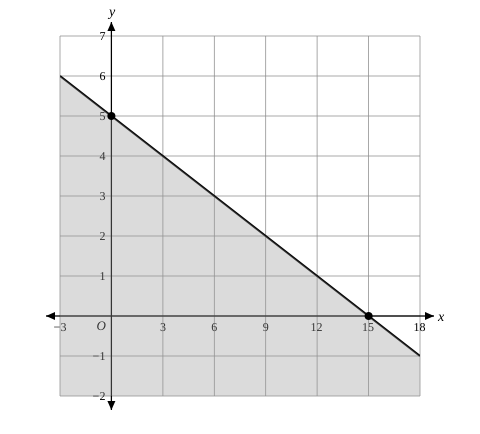
Check what one grid square is worth first. Here the horizontal One of the two lines a graph is measured against, one running across and one running up. counts by 3s and the vertical axis by 1s, so the solid line crosses at , the The output when the input is 0, which is where a graph crosses the vertical axis.Read the lesson, and , the The value of x where a graph crosses the horizontal axis, so the output there is 0.Read the lesson. Find the How steep a line is, measured by how much it goes up for each unit it moves to the right.Read the lesson and the line from those two points, as in the linear functions lesson.
Find the slope: change in over change in .
The line meets the vertical axis at , so the starting value is 5.
Solid line, shading below.
Solid or dashed tells you whether the boundary counts.
- Right
- Wrong
A solid line means the points on it are solutions, which takes or . A dashed line takes or .
Trap: Misread the picture
comes from counting five squares to the right and calling the crossing . Each of those squares is worth 3, so the crossing is at 15.
What to do: Read the numbers on each axis before you count squares. Then test a point that's clearly shaded in your answer.
When the inequality isn't solved for , the sign alone doesn't tell you which side is shaded.
Test a point off the line to find the shaded side.
- Do this
- Test the origin in . It gives , which is true, so the shading covers the origin.
- Not this
- Decide that means the shading is below the line.
Solving for means dividing by , which flips it to . That one shades above its line.
If the line runs through the origin, as does, test another point, such as .
Finding a letter from the graph
Say the shaded region below shows every solution of , where is a A number that doesn’t change, like the 7 in 5x + 7, or a letter such as p that stands for one fixed value.Read the lesson, and the question asks for .
The horizontal axis counts by 3s, so the line crosses the axes at and .
Points on the line make the two sides equal, so use an equals sign.
Put in . That's the crossing where the term isn't zero.
.
Divide both sides by 15.
Check the shading. The origin gives , which is true, and the origin is shaded.
Trap: The crossing that can't find k
9 comes from putting in . There is 0, so only gives back the 9 that's already printed. 15 is a choice too. It's the crossing itself, before any solving.
What to do: Put in the crossing where the term isn't zero. On this graph that's , where .
Now try one on a different grid.
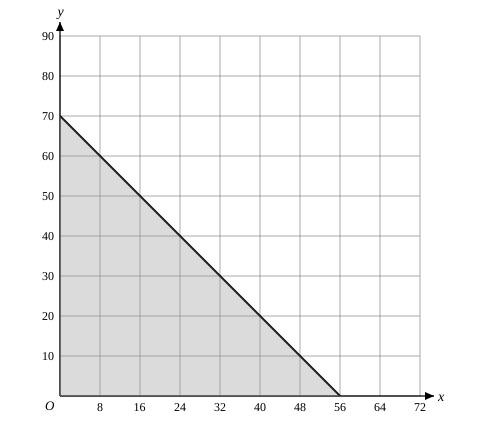
A taxi company limits its combined staffing cost for daytime and overnight shifts to $3,780. Daytime staffing costs $67.50 per hour.
In the graph, and represent daytime and overnight shift hours, respectively. The shaded region represents the solutions to , where is a constant.
What is the value of ?
- A
54
- B
67.5
- C
63
- D
70
Show the answer
- A
54
Correct answerThe boundary line passes through , so overnight hours use the full -dollar budget when there are no daytime hours. Substituting gives , so .
- B
67.5
Dividing by uses the horizontal Where a graph crosses an axis.Read the lesson in place of the vertical intercept. The represents daytime hours, so this calculation gives the daytime hourly cost.
- C
63
This comes from reading the vertical Where a graph crosses an axis.Read the lesson as , one grid interval below , and calculating . Each vertical grid interval represents hours.
- D
70
This treats the vertical Where a graph crosses an axis.Read the lesson, , as the hourly cost. That intercept represents overnight hours at the full budget; you need to substitute it into the boundary Two expressions set equal to each other, like 5x + 7 = 22.Read the lesson to find .
Solution
On the boundary line, the staffing cost equals the budget, so . The line crosses the vertical One of the two lines a graph is measured against, one running across and one running up. at , where there are daytime hours and overnight hours.
Substitute these coordinates: . This gives , so . The overnight staffing cost is dollars per hour.
Practice
Before each one, find the limit words and decide whether the boundary counts. Then check your answer in the original words.
Next steps
Drills need a free account, which also saves your lesson progress on every device. Sign up free
Related lessons