What the questions look like
A Two or more equations that all have to be true at the same time. is two equations about the same two unknowns, usually and . On a graph each one is a straight line. A solution is one pair of numbers that makes both equations true.
Read the last line first. It might say:
- “The solution to the given system of equations is . What is the value of ?” Some ask for instead.
- “What system of linear equations is represented by the lines shown?”
- “Which system of equations describes this situation?”
- “Which of the following systems of linear equations has no solution?”
- “In the given system of equations, is a A number that doesn’t change, like the 7 in 5x + 7, or a letter such as p that stands for one fixed value.Read the lesson. If the system has no solution, what is the value of ?” Here stands for one number you haven't been told, and it's the answer.
Check a pair in both equations.
- Right
- is the solution to and .
- Wrong
- is the solution to and .
works in the first equation, since . In the second it gives , so it's on only one of the lines.
If one letter is already alone, put it into the other equation. If not, make one letter cancel, or let Desmos solve it.
When one letter is already alone
The solution to the given system of equations is . What is the value of ?
The first equation says is . Put that into the second equation, in parentheses.
Multiply both terms in the parentheses by 4.
Combine and .
Add 4 to both sides.
Divide both sides by 11.
Put 3 into the first equation to get .
Check in the second equation: .
The question asks for , so the answer is 3. Once is gone, you're solving an equation with one letter, which the one-variable lesson covers.
Put the Numbers and letters combined with no equals sign, like 5x + 7.Read the lesson in parentheses, so the number in front multiplies all of it.
- Right
- Wrong
The 4 multiplies the too. Leaving it out gives , and .
The expression has to go into the other equation. If you put back into , you get , which is true for every and doesn't tell you anything.
Trap: The other letter
5 is a choice. It's the value of , worked out correctly, when the question asked for .
What to do: Write what the question asks for at the top of your scratch work, like “x = ?”, and check your answer against it before you pick.
Making one letter cancel
When both equations look like , you can add them so one letter drops out. The number in front of a letter is its The number multiplying a letter, like the 5 in 5x.Read the lesson. A letter cancels when its two coefficients are opposites, like and .
Multiply every term of the first equation by 3.
Multiply every term of the second by 4. Now the terms are and .
Add the equations: left side plus left side, right side plus right side.
is 0, so is gone.
Divide both sides by 37.
Put 17 into the second original equation.
Subtract 119 from both sides.
Divide both sides by .
Check in the first equation: .
Multiply every term, including the number on the right side.
- Right
- Tripling gives .
- Wrong
- Tripling gives .
Tripling only the left side makes a different line, and every number after it comes out wrong.
You don't always need to multiply first. In and , both terms are already .
When the matching terms have the same sign, subtract the equations. When they have opposite signs, add.
- Right
- Subtract: , so .
- Wrong
- Add: , so .
is , so adding keeps both letters. is 0.
Trap: A letter that didn't cancel
Subtracting from gives . Both letters are still there, because is .
What to do: If the letter you wanted gone is still there, check whether you should have added or subtracted.
When the question asks for x + y
Sometimes the last line asks for or , and you never need or alone. Look for the same two coefficients in swapped places, as in the system from the first section:
What is the value of ?
Add the equations.
Both letters now have 8 in front.
Divide every term by 8.
The solution is , and , so it checks. Subtracting the first equation from the second gives instead, so .
Trap: The combination done backward
When the question asks for , is a choice. It's , from subtracting the equations in the other order.
What to do: Copy the combination from the question letter for letter, in its order. A negative is a normal answer, so keep it.
Adding and subtracting equations only gives sums and differences. For a product like , solve for both letters and multiply, which here is .
If the last line asks for a multiple like , watch for it on the way. Solving and reaches a step before , so the answer is 33. If the multiple never shows up, find and multiply.
Here's one to try.
The solution to the given system of equations is . What is the value of ?
- A
- B
- C
- D
Show the answer
- ACorrect answer
Subtract the second Two expressions set equal to each other, like 5x + 7 = 22.Read the lesson from the first: . Dividing by gives .
- B
Subtracting the first Two expressions set equal to each other, like 5x + 7 = 22.Read the lesson from the second gives , which simplifies to . This reverses the requested difference.
- C
Solving the system gives , but the question asks for , not alone.
- D
Adding the Two expressions set equal to each other, like 5x + 7 = 22.Read the lesson gives , so . This computes the sum instead of the requested difference.
Solution
Subtract the second Two expressions set equal to each other, like 5x + 7 = 22.Read the lesson from the first:
Combine Parts of an expression with the same letter raised to the same power, like 5x and 2x, which you can add together.Read the lesson to get . Divide both sides by :
Therefore, the requested value is .
Writing the equations from a story
Name each unknown in words before you write anything: “ = water bottles, = hoodies.” Then turn each fact into its own equation. Often one fact is a count and the other is an amount of money.
A school club sold 58 water bottles and hoodies at a fundraiser. Water bottles cost $8, hoodies cost $14, and the club took in $590 in all.
A count equation counts each item once. A money equation multiplies each count by its price.
- Right
- and
- Wrong
- and
counts dollars, and 58 counts bottles and hoodies.
Get alone in the count equation by subtracting .
Put it into the money equation, in parentheses.
Multiply both terms by 8.
Combine and .
Subtract 464 from both sides.
Divide both sides by 6.
Find .
Check the money: .
That's 37 water bottles and 21 hoodies.
Trap: The prices swapped
gives each water bottle the hoodie price. That system says 21 water bottles, which is the number of hoodies.
What to do: Read each equation back as a sentence with its units: 8 dollars times the number of water bottles.
“Times as many” gets turned around a lot. Say a farm stand sold 5 times as many ears of corn as melons.
Put the multiplier on the smaller amount. “ is more than ” works the same way: .
- Right
- Wrong
makes the melons 5 times the corn. Test a number: 10 melons should mean 50 ears of corn, and only gives that.
If the stand sold 240 items in all, the second equation is , and gives 40 melons.
If the question only asks which system describes the story, stop once both equations match a choice. Here's a word problem to try.
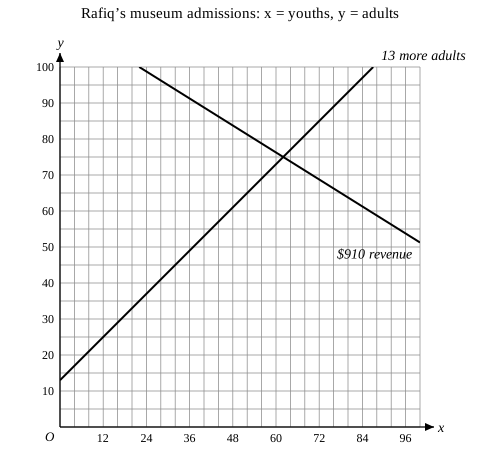
At Rafiq’s museum, adult admission cost $8, youth admission cost $5, and 13 more adults than youths visited.
How many youth visitors came to the museum that day?
- A
78
- B
75
- C
70
- D
62
Show the answer
- A
78
This results from writing the comparison backward as , which treats the number of youths as 13 greater than the number of adults and produces .
- B
75
This is the adult count, since . The question asks for the number of youth visitors.
- C
70
This results from calculating , which ignores that 13 additional adults each paid .
- D
62
Correct answerLet be the number of youth visitors. Since there were 13 more adults, the revenue Two expressions set equal to each other, like 5x + 7 = 22.Read the lesson is . Solving gives , so .
Solution
Let be the number of youth visitors. Then the number of adult visitors is .
Use the admission prices and total revenue to write . Distribute and combine Parts of an expression with the same letter raised to the same power, like 5x and 2x, which you can add together.Read the lesson:
Therefore, 62 youth visitors came to the museum that day.
Clearing fractions first
Fractions make it hard to match coefficients by hand. Multiply each whole equation by a number all its bottoms go into.
Multiply every term on both sides by the same number.
- Right
- times 12 is .
- Wrong
- without the bottoms is .
Dropping the bottoms multiplies each term by a different number, so you get a different line.
When a letter sits on the right side, move it left first.
Start from the equation.
Subtract from both sides, so both letters are on the left.
Multiply every term by 24, since 6 and 8 both go into 24.
A word problem can hand you the fractions. “One-fourth of exceeds one-sixth of by ” works like this:
“Exceeds by” means the first amount minus the second.
Multiply every term by 12.
The choices may show only the cleared form, so you'd look for .
In Desmos you can skip the cleanup and type the fractions, pressing the right arrow after each bottom number. For , type 3/4 → x+1/6 → y=5/12, where → is the right arrow. Check that both letters sit outside the fractions.
Graphs, and solving in Desmos
On a graph, the solution is the point where the lines cross.
Write the crossing as , with the horizontal number first.
- Right
- Lines crossing 3 across and 14 up meet at .
- Wrong
- Lines crossing 3 across and 14 up meet at .
is 14 across and 3 up, a different point.
Trap: A point on only one line
Say the lines cross at , and one of them meets the vertical One of the two lines a graph is measured against, one running across and one running up. at . is a choice, but it's on only one line.
What to do: Check the scale on each axis, since a square may not be 1. Trace from the crossing straight down and straight across, and make sure the point is on both lines.
“What system of linear equations is represented by the lines shown?” asks for both equations. Find each line's How steep a line is, measured by how much it goes up for each unit it moves to the right.Read the lesson and The output when the input is 0, which is where a graph crosses the vertical axis.Read the lesson from its own two labeled points. For a line through and :
Change in over change in .
The line crosses the vertical axis at , so .
Do the other line the same way. If the choices look like , move the term over to compare: is . The linear functions lesson shows how to get an equation from two points.
Typing both equations into Desmos takes about ten seconds, which is worth it when there are fractions, messy numbers, or letters on both sides. If one equation already gives you a value, like , or one subtraction finishes the work, it's quicker by hand.
Solve a system by graphing
- Type the first equation on line 1 and the second on line 2. Letters on both sides are fine. Desmos needs and , so if the letters are and , type for every and for every , and write down which is which.
- Click a line, then click the gray dot where the lines cross to read its coordinates.
If you don't see a crossing, zoom out before you decide there isn't one. The coordinates show as decimals. A value like 3.5 goes into a A question where you type your own answer instead of picking one of four.Read the lesson as it is. For a long decimal, finish by hand to get the exact fraction. The solving by graphing lesson has more.
One solution, none, or infinitely many
Put both equations in form, then compare the slopes, and after that the y-intercepts.
| Slopes | Y-intercepts | Solutions |
|---|---|---|
| Different | Any | Exactly one |
| Same | Different | None |
| Same | Same | Infinitely many |
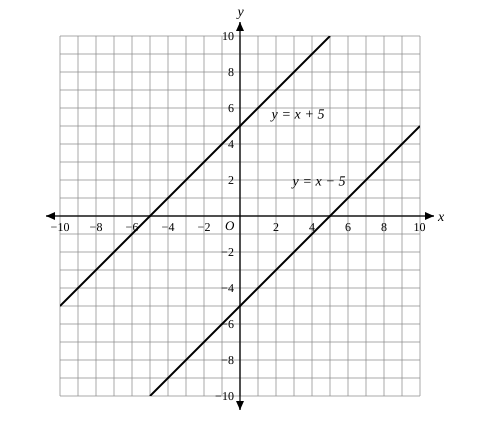
When both equations look like , multiply one so its left side matches the other's, then compare the right sides.
Triple every term of the first equation. Now the left sides match.
The right sides don't. The lines are parallel and never meet, so there's no solution.
For infinitely many solutions, one equation has to be the other times a single number, right side included.
- Right
- and have infinitely many solutions.
- Wrong
- and have infinitely many solutions.
The wrong pair doubles the left side and not the 12. is a parallel line, so that system has no solution.
Trap: The same line called parallel
Asked which system has no solution, a choice pairs with . The slopes match, but 44 is 2 times 22, so it's one line drawn twice.
What to do: Once the left sides match, always compare the right sides before you pick.
Some choices have a letter in every equation. Compare with .
Divide every term of the second equation by 6.
Same slope, , and different y-intercepts. No solution, whatever is.
A question can also add a third line to a system you've solved. Say and cross at , and the third line is . Put in : , so the third line goes through too, and the three equations have one solution. If the third line were , it would miss , and there'd be no solution.
Trap: More lines, more solutions
“Infinitely many” is a choice, because three lines seem to give more chances to cross. A solution has to be on all three lines, and is the only point on the first two.
What to do: Solve the first two equations, then test that point in the third.
Finding the constant
Here the question tells you the system has no solution and asks for the letter. Make the left sides match, then check that the right sides don't.
Triple every term of the first equation, so its term matches the .
For no solution, the terms have to match too.
Check the right sides. They're different, so the lines are parallel.
Don't skip the last row. If the second equation had been , then would make it the same line, with infinitely many solutions.
The harder version puts a letter on the right side, so the printed numbers aren't the real ones.
In the given system of equations, is a constant. If the system has no solution, what is the value of ?
Subtract from both sides of the first equation.
Multiply every term of the second equation by , so its term becomes .
For no solution, the terms have to match too.
Divide both sides by .
Check: this is the second equation times with . , so there's no solution.
Trap: Matched before moving the letter
An answer of comes from using , the printed term, as the first equation's term. That leaves out the on the right.
What to do: Move every letter to the left side first, then match.
Negative and fraction answers are normal here, so don't change your work because of one.
Now try one where the constant is squared.
In the given system of equations, is a constant less than 1. If the system has no solution, what is the value of ?
Show the answer
Accepted answers: -1/2, -0.5, -.5
Solution
Subtract from both sides of the first Two expressions set equal to each other, like 5x + 7 = 22.Read the lesson to get , then solve for : . The second equation becomes .
For the system to have no solution, the lines must have equal How steep a line is, measured by how much it goes up for each unit it moves to the right.Read the lesson and different Where a graph crosses an axis.Read the lesson. Set , which gives . Both values are less than . When , the second intercept is , so the equations describe the same line and have infinitely many solutions. When , the second intercept is , so the lines are parallel and distinct. Thus, .
The wrong answer comes from matching slopes with the printed and leaving out the on the right side. That makes the first slope , so and . Moving to the left side first leaves , with a The number multiplying a letter, like the 5 in 5x.Read the lesson of .
The wrong answer comes from taking the first line’s slope as instead of , dividing the by the instead of the by the . Then , so . Solving for divides every term by , so the slope is .
Note that , , and are examples of ways to enter a correct answer.
Practice
Before each one, write what the last line asks for. When you finish, check your answer against both equations.
Next steps
Drills need a free account, which also saves your lesson progress on every device. Sign up free
Related lessons