What the questions look like
There's one equation with two letters, usually and , and its graph is a straight line in the The grid a graph is drawn on, with one axis across and one up.. If the question names a A rule that takes in one number and gives back one number, like f(x) = 5x - 7.Read the lesson like , you want Linear functions. If it gives two equations to solve together, that's a Two or more equations that all have to be true at the same time.Read the lesson, covered in Systems of two linear equations.
Read the last line first. It might say:
- “Which equation defines line ?”
- “What is the slope of line ?”
- “What is the -coordinate of the -intercept of the graph of the given equation?”
- “Which table gives three values of and their corresponding values of for the given equation?”
- “Which equation represents this situation?”
- “Which of the following is the best interpretation of 9 in this context?”
A point is an Two numbers that give a point’s position, like (2, 70) for 2 across and 70 up. , with first. A row of a table is a point, and so is a labeled dot on a graph.
Slope and y-intercept from the equation
In , is the slope and the line crosses the vertical axis at .
The y-intercept is the point .
- Right
- The y-intercept of is .
- Wrong
- The y-intercept of is .
On the vertical axis is 0, and comes first. sits on the horizontal axis.
Trap: Slope and intercept swapped
A line has slope and passes through . is a choice. Both right numbers are in it, each in the other's place.
What to do: The number multiplying is the slope. The number on its own is where the line crosses the vertical axis.
Many equations come as instead. Get alone, then read the slope and Where a graph crosses an axis.Read the lesson.
Start.
Subtract from both sides.
Divide every term by 3.
Read the slope only once is alone. For there's a shortcut: the slope is , here .
- Right
- has slope .
- Wrong
- has slope 15.
The 15 is on the same side as . Moving it over makes it negative, and the 3 on divides it.
Multiplying every term by the same number gives the same line. , and all have slope and cross at . If no choice looks like your answer, divide each one through by a number every term shares, or compare their .
Where the line crosses an axis
An intercept is where the line crosses an axis. To find one, set the other letter to 0. At the y-intercept , and at the The value of x where a graph crosses the horizontal axis, so the output there is 0. .
With , the equation is , so .
- Right
- The x-intercept of is .
- Wrong
- The x-intercept of is .
The x-intercept is on the horizontal axis, where , so the 0 goes second.
Putting in the 0 first saves the most work when each letter has its own fraction. Say a question asks for the -coordinate of the y-intercept of .
Put in .
The whole term is 0, including the 6.
Multiply both sides by 4.
Divide both sides by 3.
Trap: Dividing by a number that's gone
2 is a choice. It divides by the 6 as well, but that 6 left with the term.
What to do: Put in the 0 before you do anything else, then work only with what's left.
Read an intercept
- Type
3y/4and press the right arrow. Without the arrow, everything you type next stays in the bottom of the fraction. - Type
-5x/6and press the right arrow again. - Type
=9. - On the next line, type
x=0. That's the vertical axis. - Zoom out until you see where the two lines cross. Click either line, then click the gray dot where they cross to read .
For an x-intercept, type y=0 instead. The point shows decimals, so reads as 1.6, which is fine on a A question where you type your own answer instead of picking one of four.Read the lesson.
A letter besides x and y
Sometimes the equation has another letter in it, and you're given a point on the line. Put the point in first to find the letter, then answer the question.
Say passes through , and the question asks for the slope.
Put in and .
Multiply.
Subtract 12 from both sides.
Divide both sides by 6.
Put back in.
Subtract from both sides.
Divide every term by 3. The slope is .
Trap: Stopping at the letter
3 is a choice. It's the value of , which you found on the way to the slope.
What to do: Reread the last line before you choose. It asked for the slope, so finish the line first.
Write the equation from two points
A line passes through and . Which equation describes it?
- A.
- B.
- C.
- D.
Slope: change in over change in , subtracting in the same order on top and bottom.
Simplify.
Put into .
times is .
Add 3 to both sides.
Check the other point. It gives , so it fits.
D is correct. Don't use as , because only a point with gives you directly. Linear functions walks through this same build with a story.
Slope from two points
The change in goes on top and the change in on the bottom.
- Right
- Wrong
The wrong one puts the change in on top. That's choice A.
B swaps the slope and the intercept. C comes from the other way to finish a line, point-slope form, .
Put in and the point .
Subtracting a negative is adding.
Multiply both terms by . times 5 is 3.
Subtract 8 from both sides.
Writing in the third row gives choice C. Use whichever route you make fewer sign slips in.
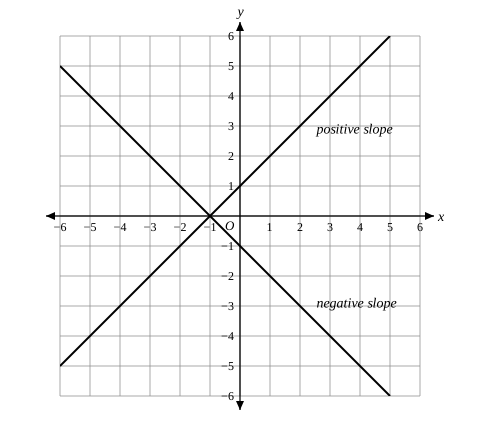
Trap: A flipped sign
comes from subtracting in two different orders, . It fits , but at it gives instead of .
What to do: Put the point you didn't use into your equation. Then check the direction: from to the line rises, so the slope is positive.
To test the choices in Desmos, type the two points and graph each choice. Any line that misses a dot is out. Linear functions shows the keys. Try one built from a graph.
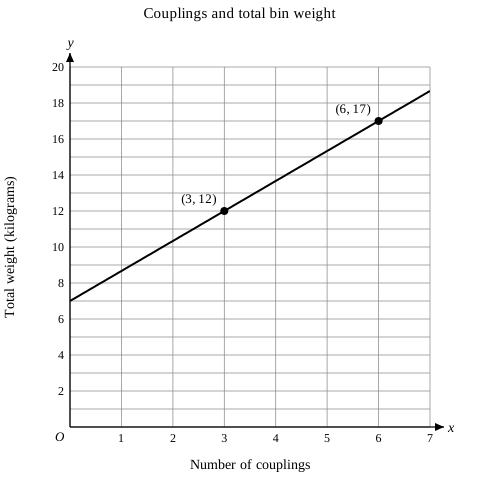
At Horvath’s scrapyard, the graph relates the number of identical steel couplings in a collection bin to the total weight , in kilograms, of the bin and couplings. The empty bin has a fixed weight. Two recorded points on the line are and .
Which equation represents this situation?
- A
- B
- C
- D
Show the answer
- ACorrect answer
The How steep a line is, measured by how much it goes up for each unit it moves to the right.Read the lesson is . Using , the Where a graph crosses an axis.Read the lesson is , so the Two expressions set equal to each other, like 5x + 7 = 22.Read the lesson is .
- B
This Two expressions set equal to each other, like 5x + 7 = 22.Read the lesson reverses the How steep a line is, measured by how much it goes up for each unit it moves to the right.Read the lesson calculation, using instead of . The Where a graph crosses an axis.Read the lesson then comes from using that reciprocal slope with .
- C
This Two expressions set equal to each other, like 5x + 7 = 22.Read the lesson swaps the roles of the How steep a line is, measured by how much it goes up for each unit it moves to the right.Read the lesson and Where a graph crosses an axis.Read the lesson. It places the intercept as the The number multiplying a letter, like the 5 in 5x.Read the lesson of and the slope as the A number that doesn’t change, like the 7 in 5x + 7, or a letter such as p that stands for one fixed value.Read the lesson term.
- D
This Two expressions set equal to each other, like 5x + 7 = 22.Read the lesson has a sign error when is distributed. The correction term should be , but changing it to produces the incorrect Where a graph crosses an axis.Read the lesson .
Solution
Use the two recorded points to calculate the How steep a line is, measured by how much it goes up for each unit it moves to the right.Read the lesson:
.
Substitute and into :
.
The -intercept also represents the weight of the empty bin, so an Where a graph crosses an axis.Read the lesson of agrees with the graph. The Two expressions set equal to each other, like 5x + 7 = 22.Read the lesson is .
Tables
A table gives you points.
| 4 | 30 |
| 7 | 45 |
Divide the change in by the change in , even when jumps by more than 1.
- Right
- The slope is .
- Wrong
- The slope is .
goes up 15 while goes up 3. That's 5 for each 1.
The -values can have a letter in them. With rows and , the cancels.
Change in over change in .
and .
Divide.
When the choices are tables, put each row's into the given equation and see if you get its . Here's a choice for .
| 1 | 7 |
| 2 | 5 |
| 3 | 4 |
Trap: A table that fits two rows
The first two rows fit, since and . The third doesn't: , and the table says 4.
What to do: Check every row. One row that misses rules out the whole table.
Reading a line off a graph
A print shop starts the week with 15 boxes of paper. Each order it prints uses 3 reams, and a box holds 5 reams. Say a graph shows the boxes left, , after orders, with the labeled points and .
The slope from the points is . The story gives the same thing: 3 reams is of a box, and the paper is being used up, so the slope is . The line is .
Trap: The story's rate in the wrong units
uses 3 reams per order as the slope. But counts boxes, and after 6 orders this line says boxes are left.
What to do: Read the units on both axes. Change the story's rate into those units before you use it as the slope.
The point is on the line. What is the value of ?
Put in , with for .
Subtract 15 from both sides.
Multiply both sides by .
On a graph, answer with the equation.
- Do this
- Pick two points that sit exactly where gridlines cross, labeled ones if there are any, and write the equation.
- Not this
- Read a missing coordinate off the picture by eye.
Between gridlines you're estimating, and the choices can be close together. The equation gives the exact number.
Some questions add a step after the line. If one asks how many reams are left after 5 orders, find the boxes first: . Then change units: 12 boxes of 5 reams is 60 reams. If a story has two machines or two workers, write each one's rate next to its name before you compare them.
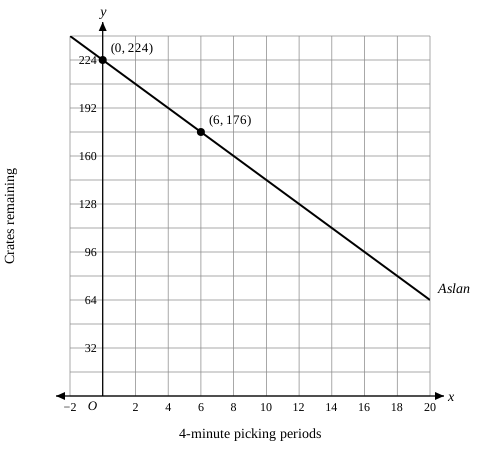
Aslan picks 2 mushroom crates per minute. The graph records crates remaining after each 4-minute period.
The point with coordinates lies on the line shown. What is the value of ?
Show the answer
Accepted answer: 72
Solution
The How steep a line is, measured by how much it goes up for each unit it moves to the right.Read the lesson is , so the number of crates decreases by during each 4-minute period. Since the line passes through , its Two expressions set equal to each other, like 5x + 7 = 22.Read the lesson is .
Substitute : .
A common wrong answer is , which uses the rate of crates per minute as the slope magnitude without converting it to crates per 4-minute period. Another common wrong answer is , which reports the given -coordinate instead of calculating the requested -coordinate.
Parallel and perpendicular lines
Parallel lines have the same slope. Their intercepts don't matter.
- Right
- A line parallel to has slope .
- Wrong
- A line parallel to has slope .
Parallel lines rise at the same rate, so the slope stays the same. is the perpendicular slope.
For a perpendicular line, flip the slope and change its sign.
- Right
- A line perpendicular to one with slope has slope .
- Wrong
- A line perpendicular to one with slope has slope .
Perpendicular slopes multiply to . times is 1.
Perpendicular slopes
Trap: Only half the change
For a line perpendicular to one with slope , the answer is . flips without changing the sign, 3 changes the sign without flipping, and is the parallel slope.
What to do: Multiply your slope by the original one. Perpendicular must give . For parallel, copy the slope as it is.
Some questions give the line as and write the choices that way too.
Which line is perpendicular to and passes through ?
- A.
- B.
- C.
- D.
The slope of is .
Flip it and change the sign.
Put in .
Multiply.
Subtract . 6 is .
Multiply every term of by 4.
Subtract from both sides, then multiply every term by .
Double every term. That's D.
D passes through , since . A flips the slope without changing its sign, and B changes the sign without flipping. C has the right slope, but it keeps the original line's intercept, 2, when it should pass through .
Two equations in this form give a faster test. and are perpendicular when : for and , . They're parallel when . The test helps most when a letter sits in a The number multiplying a letter, like the 5 in 5x.Read the lesson. Say and are perpendicular.
Multiply the numbers, multiply the numbers, and add.
Multiply out .
Combine like terms, then subtract 20 from both sides.
Divide both sides by 7.
Try one with the choices in this form.

A streaming service models basic subscribers and premium subscribers , in thousands, using line . This line contains the table’s point and is perpendicular to .
Which equation defines line ?
- A
- B
- C
- D
Show the answer
- A
You took the reciprocal of to get without changing its sign. This Two expressions set equal to each other, like 5x + 7 = 22.Read the lesson passes through , but perpendicular How steep a line is, measured by how much it goes up for each unit it moves to the right.Read the lesson must have a product of .
- BCorrect answer
The given line has How steep a line is, measured by how much it goes up for each unit it moves to the right.Read the lesson , so a perpendicular line has slope . Using gives , so . Thus , which rearranges to .
- C
You changed the original How steep a line is, measured by how much it goes up for each unit it moves to the right.Read the lesson’s sign from to without reversing the fraction. This Two expressions set equal to each other, like 5x + 7 = 22.Read the lesson fits , but the perpendicular slope requires both changes.
- D
You used the perpendicular How steep a line is, measured by how much it goes up for each unit it moves to the right.Read the lesson but kept the original line’s Where a graph crosses an axis.Read the lesson of . That gives , which yields when , missing the table’s point.
Solution
Solve the given Two expressions set equal to each other, like 5x + 7 = 22.Read the lesson for : gives . Its How steep a line is, measured by how much it goes up for each unit it moves to the right.Read the lesson is , so the slope of perpendicular line is the negative reciprocal, .
The table gives the point . Substitute it into : , so .
Therefore, has equation . Multiply by to get , then rearrange to obtain .
Shifting a line
Moving a line up or down changes where it crosses the vertical axis and leaves the slope alone. Say the graph of is shifted down 4 units, and the question asks for the new y-intercept.
Put in to find the original y-intercept.
Divide both sides by 21.
Down 4 takes 4 off. The new y-intercept is .
Find the intercept first, then move it. Up adds , and down takes off.
- Right
- Shifted down 4, has y-intercept .
- Wrong
- Shifted down 4, the line is .
The 126 isn't the y-intercept. Taking 4 off it moves the line down only .
If the question asks for the new x-intercept, write the shifted line and set .
Solve the original for : and .
Down 4: take 4 off the intercept.
Set .
Add to both sides, then multiply both sides by .
To move a line right units, replace with . Moving right 4 gives , which is . Moving left uses .
Equations from a story
Each loaf a baker shapes takes 7 minutes and each tray of rolls takes 5 minutes. She shapes loaves and trays, 258 minutes in all, so .
Each coefficient is the amount for one of whatever its letter counts. The number on the other side of the equals sign is the total.
- Right
- In , 7 is the minutes for each loaf.
- Wrong
- In , 7 is the number of loaves.
is the number of loaves. The 7 multiplies it, so 7 is the minutes for one loaf, and is the minutes for all of them.
Trap: Rates on the wrong letters
is a choice. It uses every right number, but it says each loaf takes 5 minutes.
What to do: Write the units under each term: minutes per loaf times loaves is minutes. Then check that each rate sits on the count it belongs to.
Trap: A sentence about the other number
Asked what 5 means, a choice says the baker shaped 5 trays. 5 multiplies , so it's the minutes for each tray.
What to do: Find the number the question asks about. Decide whether it multiplies a letter or is the total, then read only the choices that describe that role.
If you're given one count, put it in and solve for the other. Say she shaped 18 trays.
Put in .
Multiply.
Subtract 90 from both sides.
Divide both sides by 7.
A solution pair gives the letters in the order they're named, so first.
- Right
- means 24 loaves and 18 trays take 258 minutes.
- Wrong
- means 24 minutes of loaves and 18 minutes of trays.
The pair gives the counts, and the coefficients give the minutes for each. .
Sometimes each rate has a A number that doesn’t change, like the 7 in 5x + 7, or a letter such as p that stands for one fixed value.Read the lesson in it, like for the cost of adult and kids' tickets. If the question asks how much more an adult ticket costs, subtract: . The cancels, so you never need to find it.
Practice
Before each one, decide whether you're reading the equation, building it, relating two lines, or saying what a number means. When you build an equation, check it against a point you didn't use.
Next steps
Drills need a free account, which also saves your lesson progress on every device. Sign up free
Related lessons
- Linear functions
- Systems of two linear equations in two variables
- Linear inequalities in one or two variables
- Solving by graphing in Desmos
- Desmos for data and regression
- Plugging in numbers and working backward from the choices
- Formulas that are not on the reference sheet
- Units, percents, and grid-in entry rules
- Back to all lessons