What the questions look like
A nonlinear function has a graph that isn't a straight line. A quadratic has an term or two factors like , and its graph is a The U-shaped curve a quadratic draws, opening either up or down.. An exponential has the A letter that stands for a number you don’t know yet, like the x in 5x + 7.Read the lesson in the The small raised number that says how many times to multiply, like the 3 in x cubed.Read the lesson, as in , and it shows up whenever a story repeats a percent change. You'll also see cubes and other An expression built from powers of one letter added together, like x cubed minus 2x plus 5.Read the lesson, How far a number is from zero, so it’s never negative, like 5 for both 5 and -5.Read the lesson bars, and a variable in a The bottom number of a fraction, like the 4 in 3/4.Read the lesson.
Read the last line first. It might say:
- “What is the value of when ?”
- “What is the vertex of the graph?”
- “Which equation represents this situation?”
- “Which of the following is the best interpretation of 480 in this context?”
- “Which of the following equations displays, as a A number that doesn’t change, like the 7 in 5x + 7, or a letter such as p that stands for one fixed value.Read the lesson or The number multiplying a letter, like the 5 in 5x.Read the lesson, the minimum value of the function it defines?”
Desmos is fast when you're given a function and asked for a number. When the question asks what a number means or which form shows a feature, or the graph is already printed, leave it closed. The math guide covers typing a A question where you type your own answer instead of picking one of four.Read the lesson answer.
Put a number in, or work backward
In Writing a function as f(x), where the number in the parentheses is the one going in.Read the lesson, the number in the parentheses is the input. For , .
When the question gives you the output instead, set the whole formula equal to it. Say , and the question asks for when .
Set the formula equal to the output.
Divide both sides by 4.
Take the cube root: .
Trap: Stopped one step early
125 is a choice. It's , the line before the answer. A huge choice like 500,000,000 comes from putting 500 in as the input.
What to do: Reread the last line. It asked for , so finish the cube root.
Work backward
- Type
4x^3=500. The=drops out of the exponent on its own. - Desmos draws a vertical line. Click where it crosses the horizontal One of the two lines a graph is measured against, one running across and one running up. to read .
Quadratic or exponential?
On a table with evenly spaced inputs, compare the outputs two ways. Subtract to get the changes, and divide to get the A comparison of two amounts, like 3 to 5.Read the lesson.
A steady ratio between outputs means exponential. A steady change means a line.
- Right
- Outputs 3, 12 and 48 at inputs 0, 1 and 2 fit .
- Wrong
- Outputs 3, 12 and 48 at inputs 0, 1 and 2 fit a line.
The changes are 9 and 36, so no line fits. Each output is 4 times the one before.
Check the spacing first. If the inputs go 0, 2, 4, each change or ratio covers two steps.
On a graph, a parabola turns at its vertex. A shrinking exponential like never turns. It flattens toward the horizontal axis without reaching it, so it has no lowest point.
Where the graph crosses the axes
The The output when the input is 0, which is where a graph crosses the vertical axis.Read the lesson is the output when the input is 0. Put in 0, and every term with an in it drops out.
A quadratic written in the form has its y-intercept at . In any polynomial, the constant standing alone is the output at 0.
- Right
- For , the y-intercept is .
- Wrong
- For , the y-intercept is .
multiplies , so that term is 0 when is 0.
A zero of a function is an input that gives an output of 0. On the graph, it's an The value of x where a graph crosses the horizontal axis, so the output there is 0.Read the lesson. An expression written as factors multiplied together, like (x - 2)(x + 5), where setting each factor to zero gives a solution.Read the lesson, , shows the zeros once you flip each sign.
Set each factor equal to 0, as in nonlinear equations.
- Right
- has zeros 4 and .
- Wrong
- has zeros and 2.
at , and at . Copying the number out of each factor gets both signs wrong.
It works backward too. A cubic with zeros , 1 and 3 is , since each factor is minus a zero. has every sign backward.
Find the vertex
A parabola has two mirror-image halves. The vertical line between them runs through the vertex, and it's called the The vertical line through a parabola’s vertex that splits it into two mirror-image halves.. Find that line, then put its back into the function for the other coordinate.
Axis of symmetry
For :
For , and .
Put and into the formula, signs included.
Put 3 back into the function.
Work it out.
That's the vertex.
Trap: Half a vertex
is a choice. It pairs the right with 14, the output at 0.
What to do: The formula gives only the -coordinate. Put it back in for the -coordinate.
From factored form, the axis of symmetry is halfway between the zeros. is 0 at 6 and , so it turns at . Averaging the printed and 12 gives 3, with the sign backward.
The highest or lowest value
A quadratic written as a number times (x minus h) squared, plus k, so you can read the vertex (h, k) right off it., , shows the vertex with no work. The squared part is never negative, so is the lowest output when is positive and the highest when is negative.
Read with the opposite sign of the number you see. Read as printed.
- Right
- has its vertex at .
- Wrong
- has its vertex at .
is 0 when . The form subtracts , so the sign flips.
With in front, no output is above 11, so 11 is the maximum value. A choice calling it the minimum missed the sign of .
Trap: The input for the value
4 is a choice when the question asks for the maximum value of this . The maximum value is 11, and 4 is the input where it happens.
What to do: Check whether the last line asks for the value, the -value or the point. The value is the -coordinate.
Read points off the graph
- Type the function, such as
y=x^2-6x+14. - Click the curve. Gray dots appear at the vertex and wherever the graph crosses an axis.
- Click a dot to see its coordinates.
Zoom out if the dots are off the screen, or set a taller window with the wrench for a story model with big numbers. A clicked point shows its coordinates as decimals.
Pick the form that shows the feature
Some questions give four equivalent forms and ask which one “displays, as a constant or coefficient,” a feature. All four draw the same graph, so graphing them won't help. Match the feature to the form.
| Feature asked for | Form that shows it |
|---|---|
| Zeros | Factored form, |
| Minimum or maximum value | Vertex form, |
| y-intercept | The form |
shows the y-intercept, 14. The same function in vertex form, , shows the minimum value, 5.
For the check, find the feature without the choices. For the minimum here, .
- Do this
- Name the feature, pick the form that shows it, and check that one choice another way.
- Not this
- Multiply out all four choices to see which one is right.
All four multiply out to the same thing, so that tells you nothing.
Now try one with a letter in it.
For a constant , the function is defined by .
Which equivalent equation displays the minimum value of as an added constant?
- A
- B
- C
- D
Show the answer
- A
This An expression written as factors multiplied together, like (x - 2)(x + 5), where setting each factor to zero gives a solution.Read the lesson displays the zeros, and . Selecting it confuses the The number you put into a function, like the 4 in f(4).Read the lesson where with the minimum value of the A rule that takes in one number and gives back one number, like f(x) = 5x - 7.Read the lesson.
- BCorrect answer
Since , the term is nonnegative and equals zero at . The minimum value is therefore , which this Two expressions set equal to each other, like 5x + 7 = 22.Read the lesson displays as an added A number that doesn’t change, like the 7 in 5x + 7, or a letter such as p that stands for one fixed value.Read the lesson.
- C
This form keeps inside the Numbers and letters combined with no equals sign, like 5x + 7.Read the lesson multiplied by . Selecting it treats as the minimum without accounting for the outer factor ; the minimum value is , which is not displayed as an added A number that doesn’t change, like the 7 in 5x + 7, or a letter such as p that stands for one fixed value.Read the lesson in this Two expressions set equal to each other, like 5x + 7 = 22.Read the lesson.
- D
Treating as the minimum uses the wrong The number you put into a function, like the 4 in f(4).Read the lesson. The The vertical line through a parabola’s vertex that splits it into two mirror-image halves.Read the lesson is , so evaluating at does not give the minimum.
Solution
Factor out to get . To complete the square, take half of , which is , and square it to get .
Since , rewrite the Numbers and letters combined with no equals sign, like 5x + 7.Read the lesson as .
Because , the squared term multiplied by has a minimum of zero at . Thus, displays the minimum value, , as an added A number that doesn’t change, like the 7 in 5x + 7, or a letter such as p that stands for one fixed value.Read the lesson.
Write a quadratic from a story
Use the letter for the quantity the question names, write the other quantity with the same letter, then multiply. Say a garden's length , in meters, is 5 meters longer than its width, and its area is 84 square meters.
If is the longer side, the shorter side is minus the difference.
- Right
- Wrong
is already the longer side, so the width is . The wrong equation solves to , which is the width.
Multiply out .
Subtract 84 from both sides.
and 7 multiply to and add to .
also solves it, but a length can't be negative.
A height in feet seconds after a throw often looks like . is the starting height, so starts at 40 feet. The object hits the ground when the height is 0, at the positive solution of .
Starting value and multiplier
An exponential function looks like . is the starting value, the output at . is the multiplier. Each time goes up by 1, the output is multiplied by .
Take , the number of members in a club weeks after it opened sign-ups. At , , so only the 480 is left. One week later it's .
Trap: The wrong moment in the story
552 is a choice when the question asks for the y-intercept of . It's , the number after one week.
What to do: Put 0 in for the input and compare the result with what the story says was there at the start.
The number in front is the starting value.
- Right
- 480 is the number of members when sign-ups opened, at .
- Wrong
- 480 is the number added each week.
Adding a fixed number each week would make a line. Here each week multiplies the number by 1.15.
Trap: The right number with the wrong role
Asked what 1.15 means, a choice says the number grows 15% each month. The 15% is right, but counts weeks.
What to do: Decide what job the number does in the model. Then check the time word against what the input counts.
Percents and multipliers
Growing 6% keeps the whole amount and adds 6% of it, so the multiplier is . A 20% decrease keeps 80%, so the multiplier is .
For growth of , the multiplier is . For a decrease of , it's .
- Right
- 6% growth each year gives a multiplier of 1.06.
- Wrong
- 6% growth each year gives a multiplier of 0.06.
Multiplying by 0.06 keeps only 6% of the amount each year, a 94% drop.
To go back, subtract 1. A multiplier of 0.85 gives , a 15% decrease, because 85% remains. It's the same multiplier the percentages lesson uses.
Trap: The percent where the multiplier goes
A multiplier of 0.06 or 6 takes the number straight from “6% growth.” Going the other way, a choice calls a multiplier of 0.85 an 85% decrease.
What to do: Write the multiplier as 1 plus or minus the rate before you read the choices. Then run one period in your head.
Growth every few days or months
The exponent counts how many times the multiplier has been used.
A change every units gives an exponent of .
- Right
- 9% growth every 4 hours from 250 is , with in hours.
- Wrong
- 9% growth every 4 hours from 250 is , with in hours.
After 4 hours there should be one growth period. , but .
To change the period, put the new period's length in for the input. counts an online group's members months after it started, so it grows 20% every 6 months. At 12 months the exponent is 2, so each year multiplies the number by , a 44% increase.
Percents don't add across periods. The second 20% comes from a bigger amount, so two of them make 44% for the year.
Trap: A mismatched period
The choices may differ only in the exponent: , or . For the yearly increase in , 40 is a choice. It adds the two 20% increases.
What to do: Put in the length of one period. The exponent should come out to 1.
A fixed amount added on
Only the part that changes gets the multiplier. A phone plan with a $15 line fee plus a $40 data charge that rises 5% a year costs after years. The 15 sits outside the multiplier, so it stays 15.
Trap: The fixed part grows too
adds the fee in first, so the 15 grows 5% a year along with the data charge.
What to do: Find the amount that never changes, and make sure the multiplier doesn't touch it.
Here's one with a fixed part and a growth period of 3 weeks.
At Petra’s campground, 240 campsites are booked through the standard reservation system when tracking begins. The number of these standard bookings is modeled as increasing by 5% every 3 weeks. Another 18 campsites are reserved for seasonal guests and stay booked the whole time.
Which equation best models the total number of booked campsites, , weeks after tracking begins?
- A
- B
- C
- D
Show the answer
- A
This uses the 5% rate, , as the base, which would make the standard bookings drop to 5% of their value every 3 weeks. A 5% increase multiplies by the growth factor .
- B
The The small raised number that says how many times to multiply, like the 3 in x cubed.Read the lesson would apply the 5% increase three times every week. The increase happens once every 3 weeks, so the exponent must be , the number of 3-week periods in weeks.
- C
This adds the 18 seasonal campsites to the 240 standard bookings and then applies the 5% growth to all 258. Only the standard bookings grow. The 18 seasonal campsites stay the same, so they belong outside the A relationship where each step multiplies by the same number, like doubling every year.Read the lesson term.
- DCorrect answer
The standard bookings start at 240 when and are multiplied by once every 3 weeks, giving . Adding the 18 seasonal campsites, which do not change, gives .
Solution
Tracking begins at , when 240 standard bookings are in place. A 5% increase gives the growth factor . In weeks there are three-week periods, so the standard bookings are modeled by .
The 18 seasonal campsites stay booked and do not grow, so they are added outside the A relationship where each step multiplies by the same number, like doubling every year.Read the lesson term:
An exponential from two points
Two points, given or marked on a graph, pin down an exponential. Say the curve passes through and .
The point at input 0 gives the starting value.
Divide the outputs. That's the multiplier across 2 units.
Two units means two multipliers, and .
Check: .
Multiplier from two points
For and :
Trap: The multiplier for the whole gap
uses 9 for one unit, so it gives 16,200 at . splits the 9 in half and gives 4,050.
What to do: Ask how many input units the ratio covers, and take that root.
To check a choice in Desmos, type it as f(x)=200(3)^x, then f(2) on the next line. It shows 1800, so the curve passes through .
A shift in the exponent
In , the exponent is 0 at . For the value at 0, put 0 in.
The number in front is the value where the exponent is 0.
- Right
- For , .
- Wrong
- For , .
250 is . At the exponent is , so the model runs one period backward.
Put in 0. The exponent is .
A power of flips the fraction. , and .
Moving the shift can put a value on display, which is how a “displays as a constant or coefficient” question works for an exponential. for shrinks the whole way, since its multiplier is less than 1, so its least value is at .
Put in 5. The exponent is .
, and .
Move the shift to 5, and 864 sits in front.
The 2,048 in the original is the value at the other end, .
Shifting a graph
Here's the graph of a function , with its y-intercept marked.
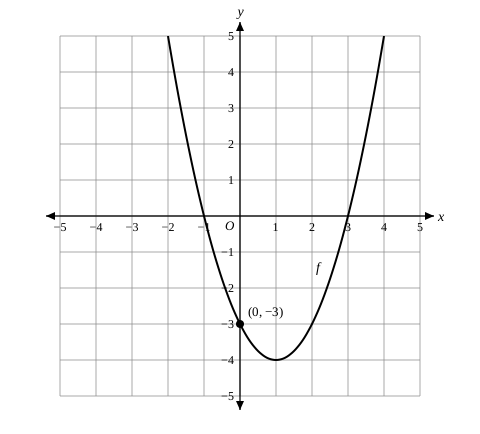
Say , and the question asks for the y-intercept of . The graph shows .
moves the graph up . moves it right , the opposite way to the sign, so has its vertex at .
- Right
- The y-intercept of is .
- Wrong
- The y-intercept of is .
Adding 7 to the output moves the graph up 7, so only the y-coordinate changes, and .
Trap: A point read from the wrong place
is a choice, and it leaves out the shift.
What to do: Read a point as across, then up, and copy its signs. For a shift added outside , change only the y-coordinate.
For a shift inside the parentheses, change the input before you work out . For a shift outside, work out first and then add or subtract.
Now try one with a graph.
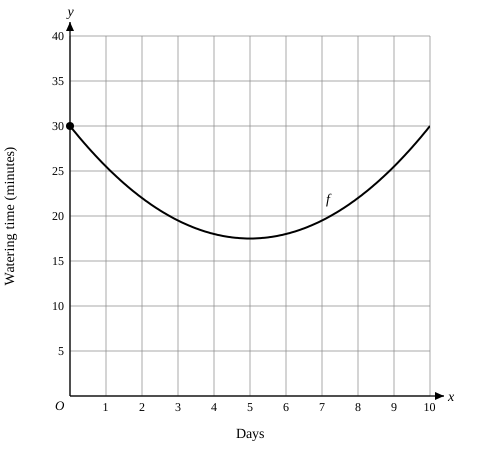
The graph of shows Adeyemi Nursery’s watering time during a 10-day cycle.
An adjusted schedule is modeled by .
What is the -coordinate of the -intercept of the graph of ?
Show the answer
Accepted answer: 35
Solution
The -intercept occurs at . The graph shows , and shifts every -value up 5 units. Therefore, . A response of reports the original -intercept without applying the vertical shift. A response of adds the shift to , the Where a graph crosses an axis.Read the lesson’s -coordinate, as if were . The value of is the intercept’s -coordinate, .
Practice
Before you answer each one, check that you have what the last line asked for.
Next steps
Drills need a free account, which also saves your lesson progress on every device. Sign up free
Related lessons