Where you'll need this
A dense passage packs more into each sentence than you can hold at your normal reading speed. It's often science or history, though either can be written plainly.
You may need some hard words, but you won't need to know the science or history itself. What the question tests is in the passage, so answer from what it says, even if something you learned in class points another way.
The passage sits on the left of the screen and the question on the right. Read the one-line question first so you know what you're reading for. Then read the passage, and say the answer in your own words before you look at the choices.
Spend the most time on passages that end in a blank (“Which choice most logically completes the text?”), on questions asking which finding would support or weaken a claim, and on questions with two texts. Their answers depend on several sentences fitting together.
A grammar question set in a long, technical sentence needs only the parts the rule uses, such as the subject and the verb. Meaning matters only for things like a verb's time or what a pronoun stands for, so you don't need to follow the science.
When to slow down
Read the first sentence and try to say it back in your own words. If you can't, switch now to one sentence at a time.
Understand the passage before you open the choices.
- Do this
- Say each sentence back to yourself before you read the next one.
- Not this
- Push on to the end while confused, then let the choices tell you what the passage meant.
A wrong choice can hand you a clear explanation the passage never gave, and once it has explained the passage to you, it feels right.
Your first read will be slower, but you get the time back at the choices, since you won't be rereading all four to work out what the passage meant.
Find the main statement
Find the verb, then ask who or what it belongs to.
“The samples collected near the spring during the second survey were unusually similar.”
The verb is “were,” and it belongs to “samples.” So the main statement is “The samples were similar.” The words in between say which samples.
Extra words between commas can split a sentence too.
“The kiln, a design borrowed from an older workshop, heated the clay evenly.”
Cover them and read what's left: “The kiln heated the clay evenly.” A pair of dashes or parentheses can fence off extra words the same way.
Some sentences put one statement inside another.
“Critics who argue that the practice began before written records rely on a single account.”
Take the outside layer first: “Critics rely on a single account.” Then go one layer in, to what they argue. The sentence is about what the critics' view rests on. It never says when the practice began.
Put the pieces back
Next, read each covered piece back in and ask what it does to the main statement. It might limit it, date it, define a word, or name a source.
“The report, which counted only households with a fixed address, put the figure at one in five.”
The main statement gives the figure, and the piece between the commas says who was counted. So the report found one in five among households with a fixed address.
Put back everything you covered.
- Do this
- Read every piece back in, all the way to the end of the sentence, before you decide what it says.
- Not this
- Keep the short version as the whole meaning.
The piece you set aside often holds the limit that decides the question, like “only households with a fixed address.”
The deciding words can come at the very end.
“The treatment reduced symptoms in every patient who completed the course.”
Stop at “every patient” and you've got the wrong claim. The last words limit it to patients who finished. The sentence says nothing about those who stopped early.
Say it in plain words
Now say the whole sentence in simpler words. When a long noun hides an action, turn it back into someone doing something.
“The displacement of tenants by rising rents reduced the district's population.”
Plain version: “Rising rents pushed tenants out, so fewer people lived in the district.” A list like “rents, tenants, population” would lose which one acted on which.
Keep how sure the sentence is, too.
“Rising rents may have contributed to the departure of tenants.”
Keep your plain version exactly as sure as the passage.
- Right
- Rising rents could have helped push tenants out.
- Wrong
- Rising rents helped push tenants out.
The passage says rents “may have contributed,” so they're only a possible cause. The second version drops the “may.”
The same goes the other way. If the passage states something flatly, adding “maybe” makes your version too weak.
Say what the sentence does
Give the sentence a short label for its job, such as “sets up a problem,” “states a claim,” “gives evidence,” “turns against an earlier idea,” or “names a limit.”
“Researchers proposed that shade slowed growth. Plants beneath screens grew less than plants in direct sunlight.”
The first sentence states a Something a passage says is true, which the rest of it backs up or limits., that shade slowed growth. The second gives Information used to back up a claim, like a study’s results or a quote. for it. Your plain version says what a sentence says, and the job is why the author put it there.
Use a label that fits the sentence in front of you. Not every science passage runs claim, experiment, result. Some describe a debate, or something in nature, with no experiment at all.
Connect it to the sentence before
For each sentence after the first, say how it links to the one before. It might add a result, explain, give an example, disagree, or limit.
“The northern village stored grain underground. The southern village used raised storehouses.”
The second sentence gives a different method to compare with the first. It doesn't say either one worked better.
Sometimes a passage sets two facts side by side and leaves the link out.
“The port tax ended in 1846. Imports doubled by 1849.”
When the passage doesn't say why, don't supply a reason.
- Do this
- Say “imports rose after the tax ended,” and note that the passage gives no reason.
- Not this
- Fill in the reason that seems obvious, that goods got cheaper once the tax was gone.
A reason you supplied isn't in the passage, however sensible it is, and a choice that states it will feel like something you already worked out.
Check before you move on
Before you go on, check that you can say the sentence you just read in plain words, name its job, and link it to the one before. If one won't come, reread that sentence now and find the words that lose you. Don't count on the next sentence to explain it. The next three sections cover the usual causes.
If you've been through the whole passage twice, about 60 seconds, and still can't say what it means, a third read rarely helps. Make your best guess, click Mark for Review, and move on.
When a word stops you
“The barrier layer, a band of cold water that prevents mixing, remained intact.”
A technical word means whatever the passage says it is or does.
- Do this
- Treat “barrier layer” as the name for the cold band that stops mixing.
- Not this
- Stop at the term because you never took that class, or fill it in from what you remember about oceans.
The passage gives you everything the question will test about it.
A technical word usually comes with its meaning close by: after a comma, between dashes or parentheses, or later in the sentence. If it doesn't, give it a short meaning from what the passage does with it, and use that meaning from then on.
General words cause more trouble. “Negligible” (too small to matter) can flip what a sentence claims. The Reading and Writing guide has a table of words like it, including the ones choices use for what an author does, such as “concedes” and “qualifies.”
Linking words tell you how two statements fit together, and missing one can leave you holding the wrong half of a sentence.
| Linking word | What it tells you |
|---|---|
| nevertheless, nonetheless | Despite what was just said |
| conversely | With the direction reversed |
| likewise, similarly | The same holds for another case |
| moreover, furthermore | Another point pushing the same way |
| consequently, hence, thus, accordingly | This follows from what came before |
| regardless, irrespective, notwithstanding | The thing just named doesn't change it |
| fittingly | Appropriately, given what was just said |
| granted, admittedly | The author gives up a point before making the real one |
“Although the ledger is incomplete, it is the only record of the shipments.”
The author grants that the ledger is incomplete, then makes the real point, that it's the only record. A choice saying the author doubts the ledger because it's incomplete takes the point the author gave away and treats it as the author's view.
When people disagree
“Ortiz argues that merchants financed the canal. Bell attributes its construction to public funding, citing municipal accounts.”
Keep each view with its owner. Ortiz says merchants paid. Bell says the public paid, and the city's accounts are Bell's evidence. A choice saying Ortiz relies on those accounts hands Bell's evidence to Ortiz.
With two texts, write one line for each author's view before you compare them. They may disagree, agree for different reasons, or agree on one point and split on another.
When a passage compares two groups or methods, keep two short columns, and put anything true of both in both. A fact in both columns can't explain a difference. If both classes used the same textbook, the textbook can't be why one class scored higher.
When numbers need sorting
“The sites were ranked by disturbance, with rank 1 assigned to the most disturbed site. Site A ranked 2, and Site B ranked 7.”
Before you compare numbers, say what each one measures and which direction means more.
- Do this
- Say what the scale means before you compare: rank 1 is the most disturbed, so a lower rank means more disturbance.
- Not this
- Assume a bigger number means more disturbance.
On a scale that runs backward, a wrong choice can match the right one in everything except direction.
So Site A was more disturbed than Site B. Dates can run backward too: 500 BCE comes before 200 BCE.
With a table or graph, read the labels and units first. “20 plants flowered” and “20 percent of the plants flowered” are different facts.
Notice whose numbers they are and when they were taken. A survey of one district in 1910 tells you about that district in 1910, and nothing about the whole country or the rest of the century.
Finish with one sentence
At the end, say the passage's The main point of a passage, which the rest of it supports.Read the lesson in one sentence, and keep it exactly as sure as the passage.
“Seeds in shallow trays sometimes sprouted earlier than seeds in deep trays. The researchers suggest that planting depth may affect sprouting time.”
A good version is “Planting depth may affect when seeds sprout.” The trays are only the evidence, so they drop out.
Look away from the screen while you say it. If it won't come, find the sentence where you lost the thread and reread just that one.
Predict before the choices
You read the question before the passage. Go back to it now and say what the answer has to do. When the passage ends in a blank, you want a conclusion the passage backs up, which is an A conclusion the passage supports without stating it outright.Read the lesson. An evidence question wants the finding that supports or weakens the claim it names.
When a blank sits in the middle of a sentence, as in a word or transition question, read to the end of the sentence first, since the clue often comes after the blank.
Your prediction doesn't have to match any choice's wording. It's a test each choice has to pass. With a table or graph, it says what the data must show, and the figure decides which choice shows it.
Check each choice
“Seeds in shallow trays sometimes sprouted earlier than seeds in deep trays. The researchers suggest that planting depth may affect sprouting time.”
Check each choice against your plain version. If a choice says two things, check each half, since one right half doesn't make it right. “Some seeds in shallow trays sprouted earlier, which proves that depth controls sprouting time” starts out matching, but the passage only says depth “may” affect it.
Trap: Borrowed wording
“The researchers found that deep trays affect which seeds sprout.” It reuses “deep trays,” “affect,” and “sprout,” but the passage is about when seeds sprout, and it only suggests an effect.
What to do: Say what the choice claims in your own words, then check whether the passage claims that.
Trap: An expected ending
“The researchers call for more study of planting depth.” Plenty of science passages end that way, but this one never says it.
What to do: Point to the sentence that says it. If you can't, cross the choice off.
When you're down to two, find the one place they differ. It might be the cause, how sure the choice is, the group it covers, or whose view it is. Then go back to the words in the passage that settle it.
Practice
Work through the three examples with the steps above. Then bring the same habits to questions in Inferences, Command of Evidence: Textual, Cross-Text Connections, and Central Ideas and Details, which often sit on dense passages.
Hold off on the choices until you've said your prediction, and note each sentence you had to reread. After a few sessions, see whether the same kinds of sentences keep stopping you.
Archaeologists excavating a wooden shipwreck wanted to determine when the vessel had been built, but no surviving document recorded its construction and several hull sections showed clear signs of repair. The oak beams, whose growth rings and intact bark edges were examined using dendrochronology, a technique for matching ring patterns to calendar years, yielded tree-felling dates rather than dates of use, since builders sometimes stored timber for years before assembling a vessel. A replacement beam could also come from a tree felled after construction, so the researchers could use a beam to establish a limit on the construction date only if it belonged to the original hull; therefore, ______
Which choice most logically completes the text?
- A
construction must have preceded the felling of trees used for original beams, although the interval could not be determined.
- B
original hull beams would place construction at or after their felling dates, without establishing exactly when construction occurred.
- C
all excavated hull beams would place construction at or after their felling dates, including beams added during later repairs.
- D
dendrochronology would establish when the vessel sank by matching growth rings in its original beams to particular calendar years.
Show the answer
- A
construction must have preceded the felling of trees used for original beams, although the interval could not be determined.
This reverses the sequence. A tree must be felled before its wood can be used to build the original hull, so construction cannot precede that felling date.
- B
original hull beams would place construction at or after their felling dates, without establishing exactly when construction occurred.
Correct answerAn original beam could be installed only after its tree was felled, so its felling date sets the earliest possible construction date. Because builders sometimes stored timber, the exact construction date remains unknown.
- C
all excavated hull beams would place construction at or after their felling dates, including beams added during later repairs.
This overreaches by applying the limit to every beam. A replacement beam may come from a tree felled after the vessel was built, so only original hull beams can set the earliest possible construction date.
- D
dendrochronology would establish when the vessel sank by matching growth rings in its original beams to particular calendar years.
This matches the passage’s references to dendrochronology, growth rings, and calendar years but assigns the technique an unsupported use. The ring patterns and intact bark edges date when a tree was felled, not when the vessel sank.
Solution
Dendrochronology gives the year in which the tree used for a beam was felled. For an original hull beam, the vessel could not have been constructed before that year because the timber first had to be available.
Construction may have occurred later if the timber was stored, so the felling date establishes only an earliest possible construction date. Replacement beams cannot establish that limit because they may have been added after the original construction. Therefore, original hull beams place construction at or after their felling dates without identifying the exact year.
The following text is from a short story. Elif and Junko are boatbuilders preparing a hull for delivery.
Junko regarded finishing a hull as eliminating evidence: no trace of a hurried brush or uncertain hand should survive inspection. Elif valued such care, especially when afternoon light revealed variations in the varnish that morning brightness had concealed. But Junko’s proposal for another inspection drew Elif’s gaze to the unused oars, whose use would introduce marks no care could prevent. Keeping the hull untouched would mean withholding it from the activity for which they had built it, an arrangement Elif could hardly defend. She folded her apron and opened the doors toward the slipway, letting reflected water tremble across the surface Junko was still considering.
Which choice best states the main idea of the text?
- A
Careful scrutiny of a newly finished hull has considerable value, since variations in lighting can expose flaws that previously escaped notice and reveal the attention required to bring the work of the builders to completion.
- B
Although Elif respects the exacting attention Junko gives the hull, she comes to regard the acceptance of future wear as necessary if their completed work is to fulfill the purpose that prompted it.
- C
Although Junko shares the respect Elif has for careful workmanship, she concludes that preserving the immaculate appearance of the hull would defeat its intended purpose and expresses readiness to release the boat for use.
- D
Finishing a wooden hull serves both decorative and protective purposes, since a coating that brings out the grain also limits contact between the wood and water during regular use of the completed vessel.
Show the answer
- A
Careful scrutiny of a newly finished hull has considerable value, since variations in lighting can expose flaws that previously escaped notice and reveal the attention required to bring the work of the builders to completion.
This choice treats Elif’s initial agreement about the value of inspection as the passage’s final position. It stops before her reflection on the unused oars leads her to accept the wear that using the boat will bring.
- B
Although Elif respects the exacting attention Junko gives the hull, she comes to regard the acceptance of future wear as necessary if their completed work is to fulfill the purpose that prompted it.
Correct answerElif values Junko’s care, but she recognizes that keeping the hull untouched would prevent its intended use. Folding her apron and opening the doors toward the slipway show her readiness to let the boat go into use and acquire marks.
- C
Although Junko shares the respect Elif has for careful workmanship, she concludes that preserving the immaculate appearance of the hull would defeat its intended purpose and expresses readiness to release the boat for use.
This choice assigns Elif’s realization and actions to Junko. Elif questions keeping the hull untouched and opens the doors, while Junko proposes another inspection and remains focused on the surface.
- D
Finishing a wooden hull serves both decorative and protective purposes, since a coating that brings out the grain also limits contact between the wood and water during regular use of the completed vessel.
This choice imports outside knowledge about the decorative and protective functions of a hull coating. The passage uses the varnish and its appearance to develop Elif’s conflict between preserving the finish and allowing the boat to be used.
Solution
The passage begins with Junko’s exacting approach to finishing the hull and Elif’s respect for that care. It turns when another proposed inspection makes Elif look at the unused oars and consider the unavoidable marks they will leave.
Elif recognizes that preserving an untouched hull would keep the boat from serving the purpose for which they built it. Her actions, folding her apron and opening the doors toward the slipway, express her readiness to release it. The The main point of a passage, which the rest of it supports.Read the lesson therefore combines her respect for careful workmanship with her acceptance of future wear as necessary for the boat to fulfill its purpose.
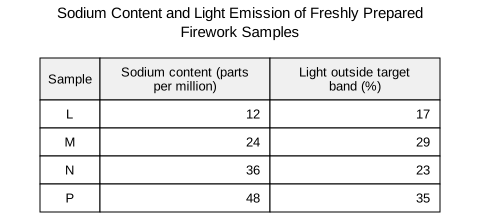
While examining compounds used to produce firework colors, chemists investigated whether traces of sodium were associated with reduced color purity. Each freshly prepared sample contained the same color-producing compound, but sodium content varied. Rather than measuring purity directly, the team recorded the percentage of emitted light outside the intended color band; lower percentages therefore indicated purer color. The chemists predicted that samples containing less sodium would produce purer colors, although other differences among samples could also affect emission. Among the freshly prepared samples, a comparison consistent with this prediction is that ______
Which choice most effectively uses data from the table to complete the statement?
- A
sample L contained less sodium than sample M and emitted 17% rather than 29% of its light outside the target band.
- B
sample M contained less sodium than sample N and emitted 29% rather than 23% of its light outside the target band.
- C
after prolonged storage, samples L and M would emit 17% and 29% of their light outside the target band, respectively.
- D
sample N emitted 23% of its light outside the target band during the measurements taken immediately after preparation.
Show the answer
- A
sample L contained less sodium than sample M and emitted 17% rather than 29% of its light outside the target band.
Correct answerSample L had less sodium than sample M, 12 parts per million compared with 24, and a lower outside-band percentage, 17% compared with 29%. Because a lower outside-band percentage indicates purer color, this comparison is consistent with the prediction.
- B
sample M contained less sodium than sample N and emitted 29% rather than 23% of its light outside the target band.
This choice reverses the purity scale by treating 29% outside the target band as purer than 23%. A higher outside-band percentage indicates lower color purity.
- C
after prolonged storage, samples L and M would emit 17% and 29% of their light outside the target band, respectively.
This choice extends the results to prolonged storage, but the table contains measurements only from freshly prepared samples. It cannot support the stated percentages after storage.
- D
sample N emitted 23% of its light outside the target band during the measurements taken immediately after preparation.
The 23% value for sample N is accurate, but it reports only one sample’s outside-band percentage. It does not compare sodium content and color purity across samples as the claim requires.
Solution
The prediction says that a sample with less sodium should have purer color. Because lower percentages of light outside the target band indicate purer color, you need a comparison in which the sample with less sodium also has the lower outside-band percentage.
Sample L had 12 parts per million of sodium and emitted 17% of its light outside the target band. Sample M had 24 parts per million of sodium and emitted 29% outside the band. Sample L therefore had both less sodium and purer color, so this comparison is consistent with the prediction.
Next steps
Drills need a free account, which also saves your lesson progress on every device. Sign up free
Related lessons